Artist in city

Michelangelo in Rome

Michelangelo first came to Rome in 1496, at 21, and carved the Bacchus for the banker Jacopo Galli and the Pieta for the French cardinal Jean de Bilhères. He returned in 1505 at the call of Julius II and spent much of the rest of his life in the city, dying there in 1564 at 88. The Roman works span nearly seven decades: the Pieta (c. 1499) in St. Peter's Basilica, the Sistine Chapel ceiling (1508-12) and the Last Judgment (1536-41), the Moses (c. 1513-15) at San Pietro in Vincoli, and the architecture of St. Peter's dome, which he designed but did not live to complete.

This page locates all major Roman sites, tells you what each holds, and gives you the booking information needed to visit without losing hours to preventable queues.

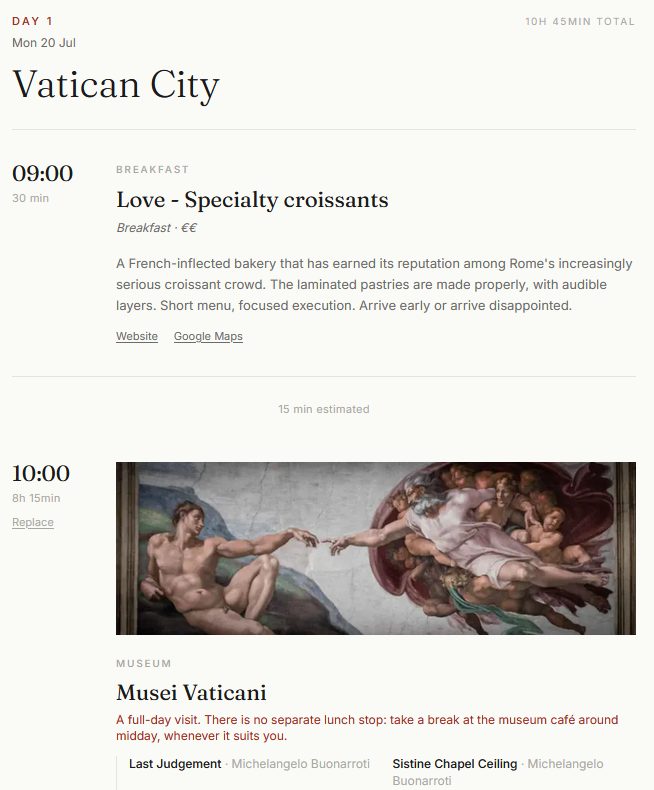
Michelangelo Buonarroti, Sistine Chapel ceiling (1508-12), Vatican Museums, Rome

Michelangelo in Rome: interactive map

Tap to activate map

What to book and what is free

The Vatican Museums require advance booking. Everything else in the Michelangelo itinerary is either free or available without a reservation.

  • Must-book: Vatican Museums (Sistine Chapel ceiling and Last Judgment). Queues without a reservation routinely exceed two hours.
  • Free, no booking: St. Peter's Basilica (Pieta, nave, apse). Entry to the Basilica is always free. The dome requires a separate ticket.
  • Free, no booking: San Pietro in Vincoli (Moses). A short walk from the Colosseum, open daily.
  • Free, no booking: Santa Maria sopra Minerva (Cristo Portacroce, 1519-21). Near the Pantheon.
  • Planning tip: San Pietro in Vincoli and the Vatican are on opposite sides of central Rome but can be combined in the same day. Vatican in the morning (book a timed slot), San Pietro in Vincoli in the afternoon, or in reverse order. Both are reachable by taxi in under 30 minutes from each other.

Where to see Michelangelo in Rome

St. Peter's Basilica: the Pieta and the dome

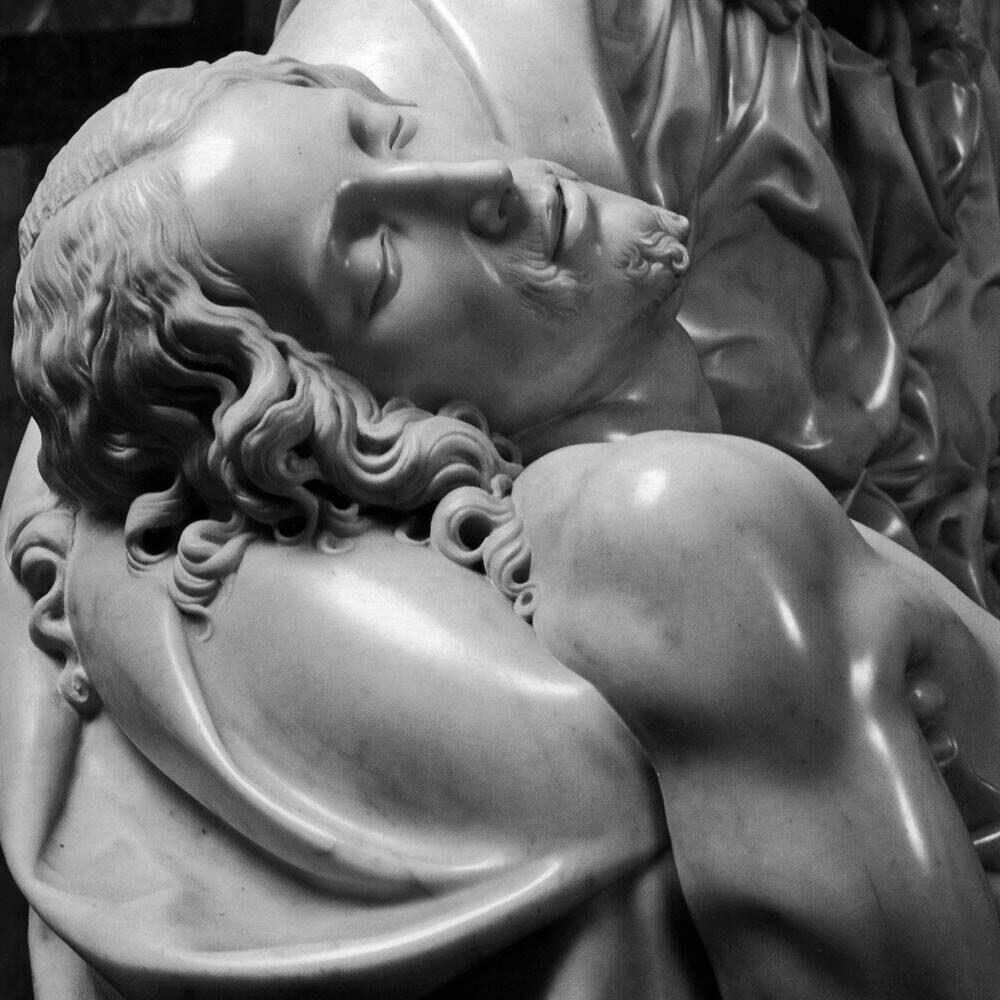
The Pieta (c. 1499) is in the first chapel on the right as you enter the Basilica, behind glass since an attack in 1972. Michelangelo was 24 when he finished it and reportedly carved his name on the band across Mary's chest after overhearing visitors attribute it to another sculptor: the only work he ever signed. The dome above the tomb of St. Peter was designed by Michelangelo from 1546 onward and completed after his death by Giacomo della Porta. Entry to the Basilica is free. Climbing the dome requires a separate ticket available on site.

Sistine Chapel: ceiling and Last Judgment

The ceiling (1508-12) was commissioned by Julius II and covers approximately 500 square metres. The nine central scenes from Genesis run along the vault: from the Separation of Light from Darkness to the Drunkenness of Noah. Surrounding them are the twelve Prophets and Sibyls, the Ancestors of Christ, and the four corner pendentives with Old Testament scenes. The Last Judgment (1536-41) covers the entire altar wall, commissioned by Paul III twenty-five years later: a single densely populated field of bodies rising, falling, and being sorted, with Christ as judge at the centre. The Sistine Chapel is accessed through the Vatican Museums. Book skip-the-line tickets or a guided tour.

Book Vatican Museums tickets

Book a guided Vatican Museums tour

San Pietro in Vincoli: the Moses

The Moses (c. 1513-15) is the central figure of the tomb of Julius II, a commission that occupied Michelangelo for over forty years and was never completed as originally planned. The figure is seated, horned (a convention in medieval and Renaissance iconography for Moses, derived from a mistranslation of the Hebrew for "rays of light"), with the tablets of the Law under his right arm and his left hand resting on his beard. The expression is one of barely contained force. The church is a 15-minute walk from the Colosseum, free to enter, and open daily. Visiting early morning or late afternoon avoids the midday tour groups.

Santa Maria sopra Minerva: the Cristo Portacroce

The Cristo Portacroce (1519-21, also called the Risen Christ) stands to the left of the main altar. It is a standing nude Christ holding the cross, originally intended to be fully unclothed; the bronze drapery covering the lower body was added later by another hand, which Michelangelo strongly objected to. The church is Gothic, built over a temple of Isis and Minerva, near the Pantheon. Opposite the Michelangelo, Fra Angelico's tomb is in the left transept. Free to enter.

Piazza del Campidoglio and the Capitoline Hill

The Piazza del Campidoglio was designed by Michelangelo in 1536 at the request of Paul III, who wanted a worthy setting for the visit of Charles V. The trapezoidal plan, the oval pavement pattern, and the positioning of the two flanking palaces (Palazzo dei Senatori and Palazzo dei Conservatori) are all Michelangelo's. The bronze equestrian Marcus Aurelius at the centre is a cast; the original is in the Musei Capitolini. The view from the top of the steps toward St. Peter's dome was also calculated as part of the design. Free to visit at any time.

Palazzo Farnese and the late architecture

Michelangelo took over the construction of Palazzo Farnese in 1546 after the death of Antonio da Sangallo the Younger and added the third floor cornice and the central window of the main facade. The building is now the French Embassy and not normally open to the public, but the exterior is visible from Piazza Farnese. It is worth including on a walk that connects the Campidoglio with the Campo de' Fiori area, both of which are free and in the same neighbourhood.
A practical Michelangelo itinerary in Rome

Day 1: Vatican axis

Vatican Museums, St. Peter's Basilica, Castel Sant'Angelo

Book a morning slot at the Vatican Museums: allow three hours minimum for the Museums and the Sistine Chapel. After exiting, St. Peter's Basilica is a five-minute walk across the square and free to enter; the Pieta is immediately to the right. If time and energy allow, climbing the dome (ticket on site) gives a close view of Michelangelo's architectural work from inside. Castel Sant'Angelo and the Ponte Sant'Angelo (Bernini's angels) are a ten-minute walk from St. Peter's Square and round out a full Vatican day.

Day 2: Colosseum axis

San Pietro in Vincoli, Campidoglio, Santa Maria sopra Minerva

San Pietro in Vincoli is a 15-minute walk from the Colosseum or a short taxi from the city centre: free, no booking, 20 minutes inside. The Campidoglio is 20 minutes west on foot, with the Musei Capitolini if you want to add a museum. Santa Maria sopra Minerva is 25 minutes north of the Campidoglio, near the Pantheon: the Cristo Portacroce is to the left of the altar, free, 10 minutes. This day covers three free Michelangelo sites across the historic centre.

One day only

Combining Vatican and San Pietro in Vincoli

Vatican Museums in the morning (book the earliest available slot), St. Peter's Basilica immediately after (free, 30 minutes for the Pieta and the nave), then taxi to San Pietro in Vincoli in the afternoon (free, 20 minutes for the Moses). This covers the three most important Michelangelo sites in Rome in a single focused day. Add Santa Maria sopra Minerva if it is on the way back toward your accommodation.

FAQ

Where can you see Michelangelo's works in Rome?

The main locations: Vatican Museums (Sistine Chapel ceiling, 1508-12, and Last Judgment, 1536-41), St. Peter's Basilica (Pieta, c. 1499, and the dome, free), San Pietro in Vincoli (Moses, c. 1513-15, free), and Santa Maria sopra Minerva (Cristo Portacroce, 1519-21, free). The Vatican Museums are the only site that requires a paid ticket and advance booking.

Do I need to book in advance to see the Sistine Chapel?

Yes. Vatican Museums queues without a reservation routinely exceed two hours. Book skip-the-line tickets or a guided tour well in advance, especially from April to October. St. Peter's Basilica, where the Pieta is located, is always free and requires no booking.

Can I see the Moses and the Sistine Chapel in the same day?

Yes. Book the Vatican Museums for the morning. After visiting the Sistine Chapel and St. Peter's, take a taxi to San Pietro in Vincoli (about 20 minutes, roughly €12-15). The church is free and the Moses takes 20-30 minutes to see properly. A morning Vatican visit and an afternoon at San Pietro in Vincoli is a practical combination that covers the three most important Michelangelo sites in Rome in one day.

Is St. Peter's Basilica free?

Yes. St. Peter's Basilica is always free to enter. The Pieta is in the first chapel on the right, behind glass. Climbing the dome requires a ticket purchased on site (approximately €8 on foot, €10 with elevator). The Vatican Museums and Sistine Chapel are a completely separate visit and require a paid ticket.

What is in the Sistine Chapel by Michelangelo?

The ceiling (1508-12) covers nine scenes from Genesis at the centre, surrounded by the twelve Prophets and Sibyls and the Ancestors of Christ. The most famous panel, The Creation of Adam, is near the centre of the vault. The Last Judgment (1536-41) covers the entire altar wall: a single composition of roughly 400 figures, with Christ as judge at the centre, the blessed rising on the left and the damned descending on the right. Both were commissioned by different popes: Julius II for the ceiling, Paul III for the Last Judgment.

Read Michelangelo in Rome on TheIntroverTraveler

Venice canal

The Restoration of the Sistine Chapel

The new restoration programme, what it means for the conservation of the ceiling and the Last Judgment, and the broader question of protecting Italy's major fresco cycles from the pressure of mass tourism.

Michelangelo's Moses

The most physically overwhelming sculpture in Rome, and one of the least visited relative to its quality. An essay on the Moses in San Pietro in Vincoli: the horns, the contrapposto, and the monument Julius II never received.

All posts about Michelangelo

The full archive of Michelangelo content on TheIntroverTraveler: sculpture analyses, fresco guides, and essays on his work across Florence, Rome, and beyond.

Rome. Where Michelangelo worked for seven popes and never quite finished the tomb of one.

The Pieta, the Sistine ceiling, the Last Judgment, the Moses, the Campidoglio, the dome of St. Peter's: six major works across six decades, in a city that kept commissioning him faster than he could deliver. The Vatican Museums require a ticket and advance booking. Everything else is free. Use the map to plan the visits in the right order before you arrive.

.js">