Priority visit
Galleria dell'Accademia
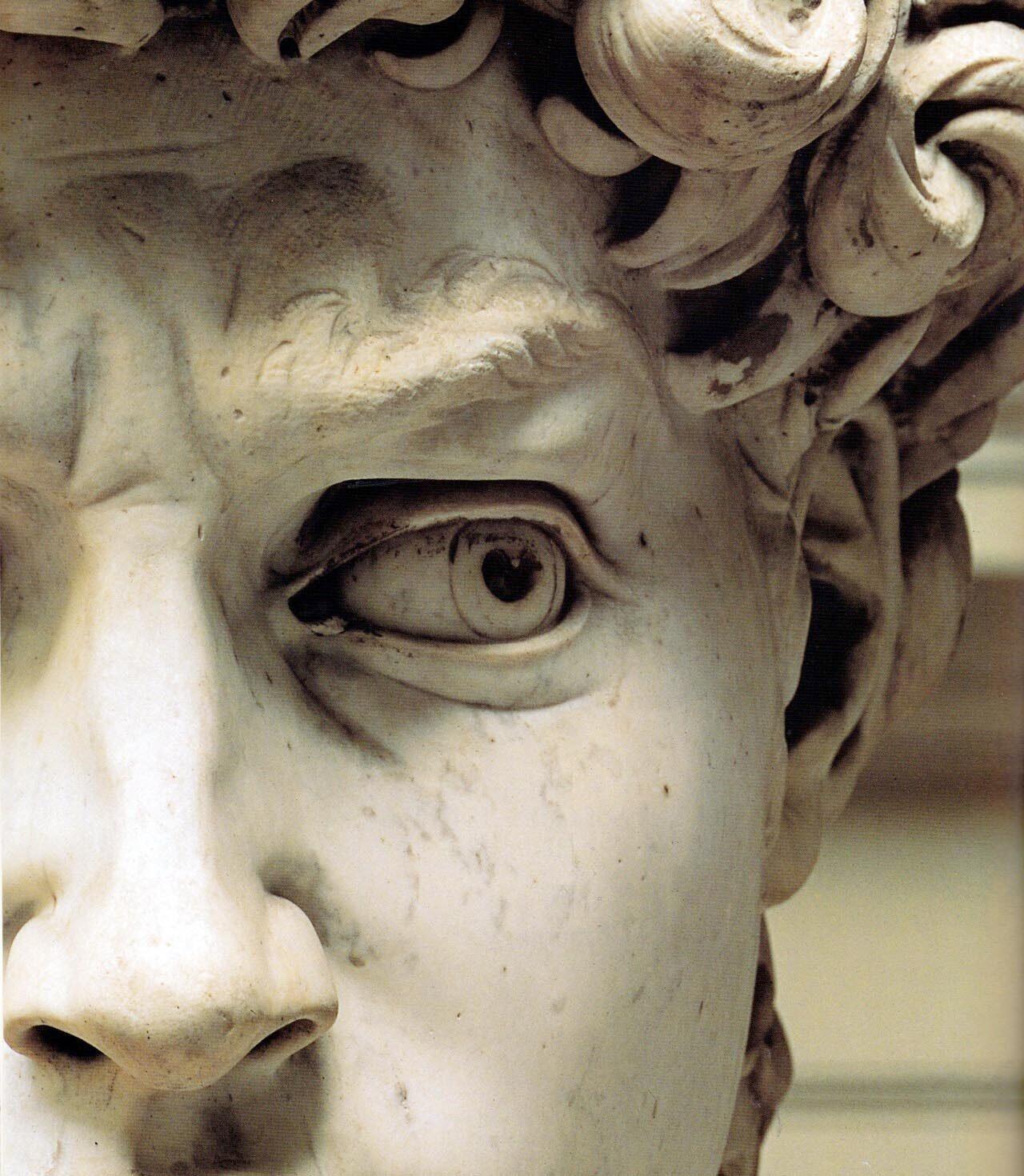
The David (1501-04) is here: 5.17 metres of Carrara marble carved from a block that two earlier sculptors had abandoned. It was commissioned for the Florence Cathedral but placed in Piazza della Signoria in 1504, where it remained until 1873. The Accademia also holds the four Prisoners (or Slaves), four unfinished figures intended for the tomb of Julius II, in which the bodies appear to be emerging from or dissolving back into the stone. They were given by Michelangelo himself to Cosimo I de' Medici. Book well in advance.
Book Galleria dell'Accademia tickets
Book a guided tour of the Accademia
Priority visit
Medici Chapels: the New Sacristy
The New Sacristy at San Lorenzo (1520-34, left unfinished when Michelangelo departed permanently for Rome in 1534) holds the tombs of Lorenzo de' Medici, Duke of Urbino, and Giuliano de' Medici, Duke of Nemours. Each tomb carries two allegorical figures: Dawn and Dusk on Lorenzo's sarcophagus, Day and Night on Giuliano's. The idealized portraits of the two dukes sit above them in niches. The space is also an architectural work: Michelangelo designed the room itself, including the pietra serena articulation of the walls. The adjacent Old Sacristy, by Brunelleschi, is a useful comparison. Also within the San Lorenzo complex: the Biblioteca Medicea Laurenziana, whose vestibule and staircase Michelangelo designed from 1524 onward: one of the strangest architectural spaces of the sixteenth century, with columns that appear to be sinking into the walls and a staircase that flows like solidified lava. The Library is open to visitors separately from the Chapels.
Book Medici Chapels tickets
Book a guided tour of the Medici Chapels
Essential museum
Bargello
The Bargello holds Michelangelo across three decades. The Bacchus (c. 1497) is his first large-scale freestanding figure, carved for the banker Jacopo Galli in Rome: a deliberately unstable, slightly drunk youth that defies the heroic conventions of the genre. The Tondo Pitti (c. 1503-05) is a relief of the Virgin and Child, left unfinished, in which the background recession is suggested rather than completed. The Brutus (c. 1539) is the only portrait bust Michelangelo ever made, commissioned after the assassination of Alessandro de' Medici by his cousin Lorenzino. The David-Apollo is an early work of uncertain identification.
Book Bargello tickets
Book Bargello + Medici Chapels combined ticket
Museum
Uffizi: the Doni Tondo
The Doni Tondo (c. 1506-08, Room 35) is the only finished easel painting by Michelangelo in existence. It was commissioned by Agnolo Doni, a Florentine merchant, probably to mark his marriage to Maddalena Strozzi. The Holy Family occupies the foreground in a tight sculptural group; a group of nude youths sits behind a parapet in the middle ground, their function still debated. The original frame, carved with five heads and probably designed by Michelangelo himself, is also in the Uffizi. Advance booking is strongly recommended.
Book Uffizi Galleries tickets
Book a guided tour of the Uffizi
Late work
Museo dell'Opera del Duomo: the Bandini Pieta
The Bandini Pieta (c. 1547-55, also known as the Florentine Pieta) was intended by Michelangelo for his own tomb and left unfinished. The figure of Nicodemus at the top, supporting Christ's body, is generally identified as a self-portrait. Michelangelo smashed the work himself, reportedly out of frustration with the marble; a student partially restored it. The museum also holds the original instruments used in the construction of Brunelleschi's dome, making it a useful stop in combination with the Medici Chapels.
Book Museo dell'Opera del Duomo tickets
Early works
Casa Buonarroti
Casa Buonarroti (Via Ghibellina 70) is a museum in the house that Michelangelo bought in 1508 and that his descendants later transformed into a memorial to him. It holds two of his earliest surviving works: the Madonna della Scala (c. 1490-92), a shallow relief in the tradition of Donatello's stiacciato technique, carved when Michelangelo was around 15 or 16, and the Battle of the Centaurs (c. 1491-92), a high relief of struggling bodies commissioned by Lorenzo de' Medici. Both are juvenilia, neither finished, but both already show the obsession with the twisting, compacted body that would define the next seven decades. Less visited than the major museums, rarely crowded, and a short walk from Santa Croce.