ⓘ Opening hours and admission prices listed on this page are indicative and subject to change. Always verify current information on the official website of each venue before your visit.
Galleria Borghese
Bernini marble groups, Caravaggio, Raphael, Titian – advance booking essential, weeks ahead
The Galleria Borghese is the single most concentrated destination for art in Rome and one of the finest small museums in the world. The ground floor holds six Bernini sculptures including Apollo and Daphne (1622–1625, Room III), The Rape of Proserpina (1621–1622, Room IV), and David (1623–1624, Room II). Canova’s Pauline Bonaparte as Venus Victrix (1805–1808) is in Room I. The upper floor has Caravaggio’s David with the Head of Goliath (c. 1609–1610), Boy with a Basket of Fruit (c. 1593), and Saint Jerome Writing (1605–1606) in Room VIII, alongside Raphael’s Deposition (1507, Room IX) and Titian’s Sacred and Profane Love (c. 1514, Room XX).
Entry is strictly capped at 360 visitors per two-hour session. Slots sell out weeks in advance, especially March through October and on weekends. This is the first booking to make when planning a Rome trip. Sessions run at 9:00, 11:00, 13:00, 15:00, and 17:00. Arrive 15 minutes early; bags must be checked.
Book Galleria Borghese timed entry |
Book a guided tour of the Galleria Borghese
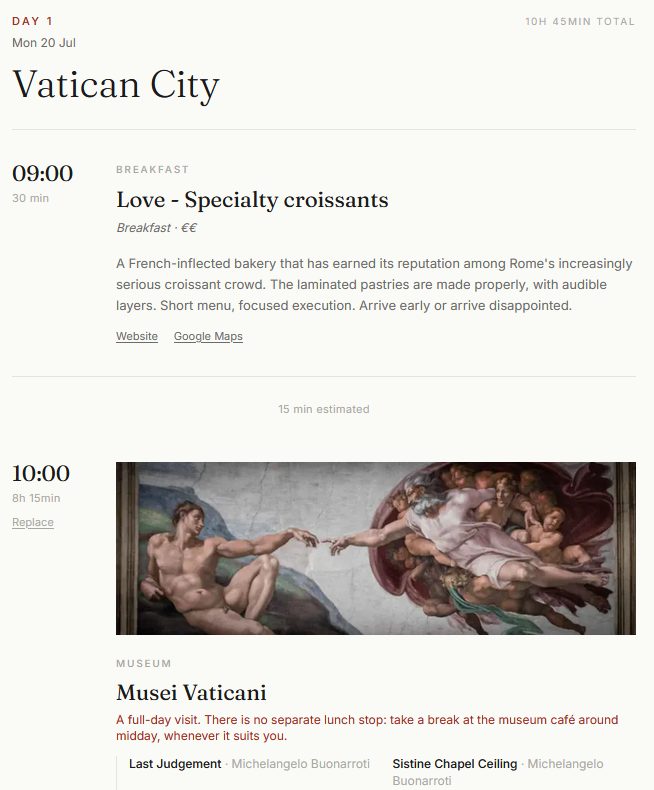
Vatican Museums and Sistine Chapel
Sistine Chapel, Raphael Rooms, Laocoön, classical sculpture – advance booking required
The Vatican Museums are one of the largest museum complexes in the world. The primary destinations for most visitors are the Sistine Chapel (Michelangelo’s ceiling, 1508–1512, and Last Judgment, 1536–1541) and the four Raphael Rooms, particularly the School of Athens (1509–1511) in the Stanza della Segnatura. The Pio-Clementino Museum holds the great classical sculptures: the Laocoön and His Sons (c. 40–30 BC), the Apollo Belvedere (c. 120–140 AD), and the Belvedere Torso. The Pinacoteca, often missed by visitors, contains Raphael’s Transfiguration (1516–1520) and Caravaggio’s Deposition (1600–1604).
Walk-in queues regularly exceed two hours. A timed-entry ticket or guided tour with skip-the-line access is strongly recommended. The Sistine Chapel is inside the museum complex; there is no separate entry. The museum opens Monday to Saturday, 8:00–19:00 (last entry 17:00). It is closed on Sundays except the last Sunday of the month, when entry is free but crowds are extreme. Book at least one to two weeks ahead in peak season.
Book Vatican Museums skip-the-line tickets |
Book a guided tour of the Vatican Museums and Sistine Chapel
Palazzo Barberini (Galleria Nazionale d’Arte Antica)
Caravaggio, Raphael’s La Fornarina, Holbein, Pietro da Cortona ceiling – less crowded than it deserves
Palazzo Barberini holds one of Rome’s great painting collections and is significantly less visited than the Borghese or the Vatican. Caravaggio’s Judith Beheading Holofernes (c. 1598–1599) and Narcissus (c. 1597–1599) are on the ground floor. Raphael’s La Fornarina (c. 1518–1520), the intimate portrait believed to show his mistress, hangs on the first floor alongside works by Filippo Lippi, Hans Holbein, and Guido Reni. The ceiling of the Gran Salone, painted by Pietro da Cortona (1633–1639, Triumph of Divine Providence), is one of the most important Baroque illusionistic ceiling paintings in Rome. The palace itself was designed by Maderno, Bernini, and Borromini.
Open Tuesday to Sunday, 10:00–18:00 (last entry 17:00). Walk-in is usually fine, even in high season. Located near Piazza Barberini, a 10-minute walk from the Trevi Fountain.
Book Palazzo Barberini tickets |
Book a guided tour of Palazzo Barberini
Musei Capitolini
Marcus Aurelius, Capitoline Venus, Dying Gaul, Caravaggio – the oldest public museums in the world
The Capitoline Museums are the oldest public museums in the world, founded in 1471. They occupy two palaces on the Capitoline Hill (Piazza del Campidoglio, designed by Michelangelo). The Palazzo dei Conservatori houses the original gilded bronze equestrian statue of Marcus Aurelius (the one in the piazza is a copy), the Capitoline Wolf, and fragments of the colossal statue of Constantine (head, hand, foot). The Palazzo Nuovo holds the Capitoline Venus, the Dying Gaul, and the Hall of the Philosophers with dozens of portrait busts. The Pinacoteca on the upper floor of Palazzo dei Conservatori has Caravaggio’s Saint John the Baptist (1602), Guercino’s Burial of Saint Petronilla, and Pietro da Cortona’s Rape of the Sabine Women.
Open daily 9:30–19:30. Walk-in is usually manageable. The underground gallery connecting the two palaces (the Tabularium) offers views over the Roman Forum.
Book Musei Capitolini tickets |
Book a guided tour of the Musei Capitolini
Palazzo Doria Pamphilj
Caravaggio, Velázquez’s Portrait of Innocent X, Flemish masters – still family-owned
One of Rome’s most atmospheric collections, still owned by the Doria Pamphilj family and displayed in the private apartments of their palace on Via del Corso, near the Pantheon. Velázquez’s Portrait of Innocent X (1650) is in the Gabinetto, widely considered one of the finest portraits ever painted. Caravaggio’s Rest on the Flight into Egypt (c. 1597) and Penitent Magdalene (c. 1594–1595) are in the Gallery of Mirrors wing. Other highlights include Titian’s Salome with the Head of John the Baptist and works by Memling, Brueghel, and Guercino. The free audio guide, narrated by a family member, adds genuine context about the palace and collection.
Open daily 9:00–19:00 (last entry 18:00). Walk-in is usually fine. About 5 minutes on foot from the Pantheon.
Book Palazzo Doria Pamphilj tickets
Galleria Colonna
Annibale Carracci, Bronzino, Veronese – open Saturdays only (and some special openings)
The Colonna Gallery, in the private Palazzo Colonna near Piazza Venezia, is one of Rome’s most spectacular Baroque interiors. The Great Hall, with ceiling frescoes by Giovanni Coli and Filippo Gherardi, leads into rooms with Annibale Carracci’s The Bean Eater (c. 1584–1585), Bronzino’s Venus, Cupid, and Satyr, Veronese, Tintoretto, and Guido Reni. The gallery is only open to visitors on Saturday mornings (9:00–13:15) and by special appointment, so plan accordingly.
Book Galleria Colonna tickets
Pantheon
Best-preserved ancient Roman building, burial site of Raphael – ticketed entry since 2023
The Pantheon (c. 118–128 AD) is the best-preserved building from ancient Rome and one of the most influential structures in the history of architecture. The unreinforced concrete dome, with its 9-metre oculus open to the sky, remained the largest in the world until the 15th century. Raphael is buried here (second niche on the left), as are two Italian kings. Since 2023, entry requires a €5 ticket; a guided tour is also available. Open Monday to Saturday 9:00–19:00, Sunday 9:00–18:00.
Book a Pantheon guided tour |
Book the combined Pantheon and Castel Sant’Angelo ticket
Castel Sant’Angelo
Mausoleum of Hadrian, papal fortress, panoramic terrace over the Tiber
Built as the mausoleum of Emperor Hadrian (139 AD) and converted into a papal fortress in the medieval period, Castel Sant’Angelo offers one of the most layered visits in Rome: ancient structure, medieval fortifications, Renaissance papal apartments with frescoes by Perino del Vaga and others, and panoramic views from the terrace. The covered passageway connecting it to the Vatican (the Passetto di Borgo) is visible from outside. Open daily 9:00–19:30. About 15 minutes on foot from Piazza Navona.
Book Castel Sant’Angelo tickets |
Book a guided tour of Castel Sant’Angelo
Palazzo Venezia (Museo Nazionale del Palazzo di Venezia)
Early Renaissance palace, decorative arts, temporary exhibitions – Piazza Venezia
One of Rome’s earliest Renaissance palaces (built 1455), overlooking Piazza Venezia. The permanent collection includes medieval and Renaissance ceramics, bronzes, tapestries, and paintings by Giorgione, Pastura, and various 15th-century masters. The palace also hosts significant temporary exhibitions. Often quiet even at peak times.
Book Palazzo Venezia tickets
Palazzo Altemps
Ludovisi and Mattei classical sculpture collections in a Renaissance palazzo – near Piazza Navona
Palazzo Altemps, a 15th-century palace a few steps from Piazza Navona, houses two major private antiquities collections: the Ludovisi and the Mattei. Key works include the Ludovisi Throne (5th century BC), the Grande Ludovisi Sarcophagus (c. 250 AD), the colossal head of Hera, and Galata Suicida (a Roman marble copy of a Hellenistic bronze). The painted loggia and frescoed rooms are part of the experience. One of the least crowded and most rewarding museums in Rome.
Book Palazzo Altemps tickets
Villa Farnesina
Raphael’s Triumph of Galatea, Loggia of Psyche, Peruzzi frescoes – Trastevere
Built for banker Agostino Chigi in 1506–1510, Villa Farnesina in Trastevere is one of the finest Renaissance villas in Rome. The ground floor Loggia of Psyche has ceiling frescoes designed by Raphael and executed by his workshop (1517–1518). Raphael’s own Triumph of Galatea (c. 1512) is in the adjacent room. Baldassare Peruzzi’s Sala delle Prospettive on the upper floor creates an extraordinary trompe-l’oeil architectural illusion. Open Monday to Saturday, 9:00–14:00. Often missed by visitors.
Book a guided tour of Villa Farnesina
Casino Ludovisi (Casino dell’Aurora)
Guercino’s Aurora ceiling, Caravaggio’s only surviving ceiling painting – limited access
This small garden pavilion, the only surviving fragment of the vast Villa Ludovisi, contains two extraordinary ceilings: Guercino’s Aurora (1621) in the main room and Caravaggio’s only known ceiling painting, Jupiter, Neptune, and Pluto (c. 1597), in the alchemical cabinet. Access is limited and by reservation only. Check availability in advance.
Casino Ludovisi official site (check visiting hours)