Rome
ⓘ Opening hours and admission prices listed on this page are indicative and subject to change. Always verify current information on the official website of each venue before your visit.
Vatican Museums (Raphael Rooms and Pinacoteca)
Stanze di Raffaello (second floor) – Pinacoteca, Room VIII – book 2–3 weeks ahead
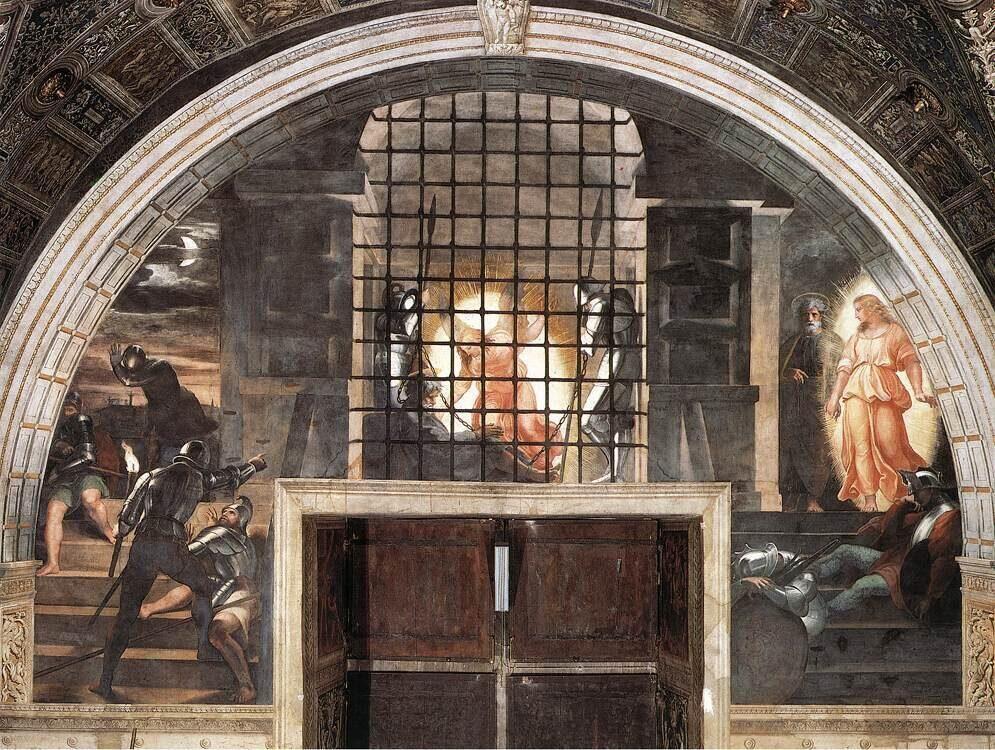
The four Raphael Rooms (Stanza della Segnatura, Stanza di Eliodoro, Stanza dell'Incendio di Borgo, Sala di Costantino) contain the School of Athens (1509–1511), the Disputation of the Holy Sacrament, the Expulsion of Heliodorus, and the Fire in the Borgo. The Pinacoteca in a separate wing holds the Transfiguration (1516–1520, his last painting), the Madonna of Foligno (1511–1512), and the Oddi Altarpiece (Coronation of the Virgin, 1502–1503). One ticket covers both areas. Early morning entry or Friday evening openings help avoid the worst crowds.
Book Vatican Museums tickets |
Vatican Museums guided tour (with Sistine Chapel)
Galleria Borghese
Room IX – timed entry required, book 3–4 weeks ahead
The Deposition (Borghese Entombment, 1507), painted for the Baglioni family chapel in Perugia, is among Raphael's most ambitious and emotionally intense compositions. Also here: the Lady with a Unicorn (c. 1506) and the Portrait of a Man. Visits are limited to 2-hour time slots, maximum 360 visitors per session.
Book Galleria Borghese reserved entry |
Galleria Borghese guided tour
Villa Farnesina
Trastevere, Via della Lungara – open Mon–Sat 9:00–14:00
Raphael frescoed the Triumph of Galatea (1512) on the ground floor and designed the Loggia of Cupid and Psyche (1518–1519, partly executed by his workshop, including Giulio Romano). The villa, built for banker Agostino Chigi, is a 10-minute walk from Palazzo Corsini. No advance booking usually required, but check for temporary closures.
Villa Farnesina guided tour
Santa Maria della Pace
Chiostro del Bramante area – limited opening hours
The Sibyls fresco (1514) above the Chigi Chapel entrance shows four Sibyls receiving instruction from angels. The church is near Piazza Navona. Opening hours are irregular: check locally or visit when the Chiostro del Bramante hosts exhibitions (separate entrance).
Santa Maria del Popolo (Chigi Chapel)
Piazza del Popolo – free entry
Raphael designed the architecture and decoration program of the Chigi Chapel (c. 1513–1516), including the dome mosaics depicting God the Father and planetary symbols. The chapel also contains later additions by Bernini. The church is free and open daily, making it an easy first stop after arriving at Piazza del Popolo metro station.
Palazzo Barberini (Gallerie Nazionali di Arte Antica)
Via delle Quattro Fontane – Room 3 (first floor)
Houses the La Fornarina (c. 1518–1520), traditionally identified as a portrait of Raphael's lover, Margherita Luti. The painting was found in his studio at his death. The museum also holds works by Caravaggio, Lippi, and Holbein. No advance booking typically needed.
Book Palazzo Barberini tickets
Galleria Doria Pamphilj
Via del Corso – Room I
Contains the Double Portrait (Andrea Navagero and Agostino Beazzano, c. 1516). A privately owned palace collection, open daily. Five minutes on foot from the Pantheon.
Book Galleria Doria Pamphilj tickets
Florence
Galleria degli Uffizi
Room 66 – book 1–2 weeks ahead in high season
The Madonna of the Goldfinch (1506), painted for Lorenzo Nasi's wedding, shows Raphael's absorption of Leonardo's sfumato during his Florentine period. Room 66 also holds the Self-Portrait (c. 1504–1506) and the Portrait of Leo X with Two Cardinals (1518–1519). In summer, morning time slots sell out fast.
Book Uffizi tickets |
Uffizi guided tour
Palazzo Pitti (Palatine Gallery)
Sala di Saturno and Sala di Giove – combined ticket with Boboli Gardens available
The Palatine Gallery holds one of the world's finest concentrations of Raphael: the Madonna della Seggiola (c. 1513–1514, Sala di Saturno), the Donna Velata (c. 1515, Sala di Giove), the Donna Gravida (c. 1505–1506), and the Madonna del Granduca (c. 1505). Allow at least 90 minutes for the Palatine Gallery alone.
Book Palazzo Pitti tickets |
Palazzo Pitti guided tour
Urbino
Galleria Nazionale delle Marche (Palazzo Ducale)
First floor – open Tue–Sun
Raphael's birthplace city holds the Portrait of a Lady (La Muta, c. 1507) and a small Santa Caterina d'Alessandria predella. The palazzo itself, designed by Luciano Laurana, is one of the finest Renaissance architectural achievements. Raphael's birth house (Casa Natale di Raffaello, Via Raffaello 57) is a 5-minute walk and shows a fresco (Madonna col Bambino) attributed to his father, Giovanni Santi, or to the young Raphael himself.
Galleria Nazionale delle Marche guided tour |
Official site
Other cities
Museo del Prado, Madrid
Room 49 – book online to skip queues
The Prado holds several important Raphaels: the Holy Family with a Lamb (1507), the Portrait of a Cardinal (c. 1510–1511), the Madonna of the Rose (c. 1517), and Christ Falls on the Way to Calvary (Lo Spasimo di Sicilia, 1515–1516). All are in the Italian Renaissance galleries on the first floor.
Book Museo del Prado tickets
National Gallery, London
Room 8 (Sainsbury Wing) – free entry, donations welcome
Outstanding group of early to middle-period works: the Mond Crucifixion (1502–1503), the Ansidei Madonna (1505), the Saint Catherine of Alexandria (c. 1507), the Garvagh Madonna (c. 1509–1510), and the Pope Julius II portrait (1511–1512). Free entry, no booking required for permanent collection.
National Gallery London guided tour
Gemäldegalerie, Berlin
Room 29 – open Tue–Sun
Five Raphael Madonnas, including the Solly Madonna (c. 1502), the Diotalevi Madonna (c. 1503), and the Colonna Madonna (c. 1508). An unusually rich concentration of his early Umbrian and transitional works.
Book Gemäldegalerie Berlin tickets
Pinacoteca di Brera, Milan
Room XXIV – book online recommended
The Marriage of the Virgin (Lo Sposalizio, 1504) is Raphael's early showpiece, painted at age 21 for the church of San Francesco in Città di Castello. It demonstrates his mastery of Perugino's spatial clarity while surpassing it. A single-work pilgrimage destination.
Pinacoteca di Brera guided tour
Pinacoteca Ambrosiana, Milan
Room 5 – near the Duomo
Contains the monumental preparatory cartoon for the School of Athens, one of the most important Renaissance drawings in existence. The full-scale charcoal and chalk cartoon spans roughly 2.8 by 8 meters and shows Raphael's compositional planning before the Vatican fresco.
Book Pinacoteca Ambrosiana tickets
Galleria Nazionale di Bologna (Pinacoteca Nazionale)
Room 15 – open Tue–Sun
The Saint Cecilia (c. 1514) was painted for the Bentivoglio Chapel in San Giovanni in Monte, Bologna. The composition shows five saints in quiet contemplation, with musical instruments scattered on the ground. One of Raphael's most serene altarpieces.
Pinacoteca Nazionale Bologna (official site)