ⓘ Opening hours and admission prices listed on this page are indicative and subject to change. Always verify current information on the official website of each venue before your visit.
Palazzo Ducale, Mantua
Camera degli Sposi (1465–1474) – timed entry required, book 2+ weeks ahead in summer
The Camera degli Sposi (Camera Picta) is the essential Mantegna destination. Located in the north-east tower of the Castello di San Giorgio within the Palazzo Ducale complex, this room is entirely frescoed with portraits of the Gonzaga family, courtly scenes, and the famous oculus on the ceiling (a trompe-l'oeil open sky with putti and figures looking down). Visits are limited to groups of about 15 people for 15-minute slots. The rest of the Palazzo Ducale includes Pisanello's unfinished Arthurian frescoes and Rubens canvases in the Galleria degli Specchi.
Palazzo Ducale Mantua (official site)
Palazzo Te, Mantua
Giulio Romano, not Mantegna, but essential context for Gonzaga patronage
Palazzo Te (a 20-minute walk south of Palazzo Ducale) was designed by Giulio Romano for Federico II Gonzaga. While it contains no Mantegna works, visiting it alongside the Camera degli Sposi clarifies how Gonzaga court culture shaped artistic ambition across generations. The Sala dei Giganti and Sala di Psiche are the highlights. Open Tuesday to Sunday, no advance booking usually needed.
Palazzo Te (official site)
Basilica di Sant'Andrea, Mantua
Mantegna's burial chapel with his funerary monument – free entry
Mantegna is buried in the first chapel on the left in this Leon Battista Alberti-designed basilica. The chapel contains a bronze bust portrait of the artist and frescoed decoration attributed to his workshop, including a Holy Family and Baptism of Christ. The basilica itself (completed after Alberti's death) is one of the finest Renaissance churches in northern Italy. A 5-minute walk from Palazzo Ducale.
Pinacoteca di Brera, Milan
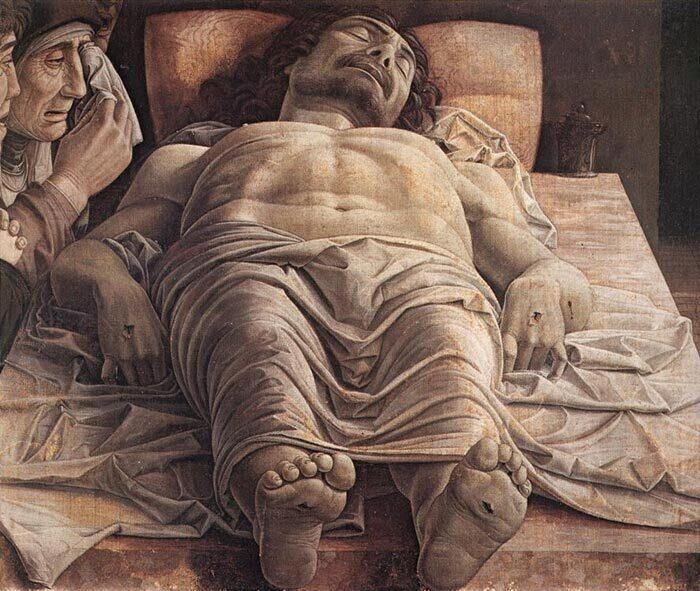
Lamentation over the Dead Christ (c. 1480), Room VI – book 1–2 days ahead
The Dead Christ is Mantegna's most reproduced painting: a drastically foreshortened view of Christ's body laid out on a marble slab, seen from the feet. It hangs in Room VI alongside other works from the Venetian and Northern Italian Renaissance (Bellini's Pietà, Carpaccio). Brera also holds Mantegna's St. Luke Polyptych and a Madonna and Child. The museum is open Tuesday to Sunday, 8:30–19:15. Online booking recommended for weekends.
Book Pinacoteca di Brera guided tour
Chiesa degli Eremitani, Padua
Ovetari Chapel fragments (1448–1457) – free entry, open daily
Mantegna's Ovetari Chapel frescoes, depicting the lives of Saints James and Christopher, were largely destroyed by Allied bombing in March 1944. Surviving fragments include the Assumption of the Virgin and parts of the St. James narrative, notable for their dramatic perspective (the Martyrdom of St. James is seen from a worm's-eye view). The church is directly adjacent to the Musei Civici agli Eremitani and a 2-minute walk from the Scrovegni Chapel (Giotto).
Musei Civici Eremitani Padua (official site)
Scrovegni Chapel / Musei Civici, Padua
Not Mantegna, but essential context – book 2+ weeks ahead
The Scrovegni Chapel (Giotto's fresco cycle, c. 1303–1305) is the reason most visitors come to Padua. Combine it with the Eremitani (Mantegna) and the Musei Civici (which hold a few Mantegna-attributed works). Scrovegni visits are strictly timed: 25 minutes maximum, groups of 25. In high season, slots can sell out weeks in advance.
Book Scrovegni Chapel tickets
National Gallery, London
The Agony in the Garden (c. 1458–60), The Introduction of the Cult of Cybele – free admission
The National Gallery holds several important Mantegna panels. The Agony in the Garden hangs in the Sainsbury Wing alongside Bellini's version of the same subject, making a direct comparison between the two brothers-in-law. The monochrome Introduction of the Cult of Cybele in Rome (1505–06) demonstrates Mantegna's late archaeological style. Also here: the Triumph panels fragment and a Samson and Delilah. Open daily 10:00–18:00 (Fridays until 21:00).
Book National Gallery London guided tour
Hampton Court Palace, London
The Triumphs of Caesar (c. 1484–1506), Lower Orangery – included with palace ticket
Mantegna's nine monumental canvases depicting Caesar's triumphal procession are displayed in the Lower Orangery at Hampton Court. These are among the largest and most ambitious Renaissance paintings in existence (each canvas approximately 2.7 × 2.8 m). They were purchased by Charles I in 1629 and have been at Hampton Court since. The Orangery is part of the general palace visit. Allow 2–3 hours for the full palace; Hampton Court is about 35 minutes by train from London Waterloo.
Book Hampton Court Palace tickets
Musée du Louvre, Paris
St. Sebastian (c. 1480), Crucifixion (predella from San Zeno), Madonna della Vittoria (1496) – timed entry recommended
The Louvre holds a significant Mantegna group in the Grande Galerie (first floor, Denon Wing). The St. Sebastian is displayed alongside other Italian Renaissance works. The Madonna della Vittoria, originally an altarpiece for a church in Mantua, is one of Mantegna's largest panel paintings. The predella panels from the San Zeno Altarpiece (the main panels remain in Verona) are also here: Crucifixion, Agony in the Garden, and Resurrection.
Book Louvre guided tour
Kunsthistorisches Museum, Vienna
St. Sebastian (c. 1457–59), other panels – Room V, first floor
Vienna's Kunsthistorisches Museum holds an early St. Sebastian (distinct from the Louvre version) along with smaller devotional works. The painting hangs in the Italian Renaissance galleries on the first floor. The museum's broader collection (Titian, Caravaggio, Veronese, Raphael) makes it a full-day destination. Open Tuesday to Sunday; Thursday until 21:00.
Book Kunsthistorisches Museum Vienna tickets
Galleria degli Uffizi, Florence
Adoration of the Magi (triptych, c. 1460), Circumcision, Portrait of Cardinal Carlo de' Medici – book 1+ week ahead
The Uffizi holds Mantegna's small-scale triptych of the Adoration of the Magi, Circumcision, and Ascension, displayed in the rooms dedicated to 15th-century Northern Italian painting (second floor). These intimate panels show Mantegna's jewel-like precision and his debt to Flemish detail. The Uffizi is extremely busy; book timed entry at least a week in advance, earlier for summer.
Book Uffizi tickets
Gemäldegalerie, Berlin
Presentation of Christ in the Temple (c. 1453), Madonna and Child – open Tue–Sun
Berlin's Gemäldegalerie holds an early Mantegna Presentation in the Temple, notable for its compressed composition and the figures pressed against the picture plane. This can be compared directly with Bellini's version of the same subject in the Querini Stampalia (Venice). The museum also has a Madonna and Child. Allow half a day for the full Italian collection, which includes major Raphael, Caravaggio, and Titian works.
Book Gemäldegalerie Berlin tickets
Museo di Capodimonte, Naples
St. Euphemia (1454), Portrait of Francesco Gonzaga – book 1–2 days ahead
Capodimonte holds one of Mantegna's earliest signed and dated works: the St. Euphemia panel (1454). The collection is on the first floor of the Bourbon palace. Combine with the museum's exceptional Titian, Caravaggio, and Parmigianino holdings.
Book Museo di Capodimonte tickets
Metropolitan Museum of Art, New York
Adoration of the Shepherds (c. 1450–51), Madonna and Child – pay-what-you-wish for NY residents
The Met holds an early Adoration of the Shepherds and other devotional panels in the European Paintings galleries (second floor, rooms 601–632). New York residents and students can enter on a pay-what-you-wish basis; other visitors pay a fixed admission.
Book Metropolitan Museum guided tour
Basilica di San Zeno, Verona
San Zeno Altarpiece (1456–59), main altar – small entry fee
Mantegna's San Zeno Altarpiece remains on the main altar of this Romanesque basilica (the predella panels in the Louvre and Tours are copies installed in their place). The triptych shows the Madonna and Child enthroned with saints, framed by painted classical architecture that extends the real columns of the church. Verona is 40 minutes by train from Mantua, making a combined visit practical.
Castelvecchio Verona (official site, nearby)
Museo Poldi Pezzoli and Pinacoteca Ambrosiana, Milan
Smaller Mantegna works – check current displays
Both Milan museums occasionally display Mantegna-attributed or workshop works. The Poldi Pezzoli holds a Madonna and Child, and the Ambrosiana has related northern Italian Renaissance material. Combine with Brera for a full Milan Mantegna day.
Book Pinacoteca Ambrosiana tickets