ⓘ Opening hours and admission prices listed on this page are indicative and subject to change. Always verify current information on the official website of each venue before your visit.
Basilica dei Frari, Venice
Assunta (1516 – 1518), Pesaro Madonna (1519 – 1526) – no advance booking required
The Assunta (Assumption of the Virgin) dominates the high altar, a painting that redefined Venetian altarpiece scale when it was unveiled in 1518. The composition rises in three tiers: the apostles below, Mary ascending, and God the Father above. Across the left nave, the Pesaro Madonna (in the Pesaro family chapel) introduced a radically asymmetric altarpiece format. Both paintings remain in their original positions. The Frari is open Mon – Sat 9:00 – 18:00, Sun 13:00 – 18:00. Arrive before 10:00 to see the Assunta with morning light from the apse windows.
Basilica dei Frari official site
Gallerie dell'Accademia, Venice
Pietà (ca. 1576), Presentation of the Virgin (1534 – 1539) – book 2 – 3 days ahead in high season
The Pietà, Titian's final painting (completed after his death by Palma il Giovane), hangs in a dedicated room. It is one of the most radical works in Western art: the forms dissolve into rough, layered brushwork. The Presentation of the Virgin is displayed in the large room originally built for it (the former Sala dell'Albergo of the Scuola della Carità). Allow 1.5 hours for the full collection.
Book Gallerie dell'Accademia guided tour
Palazzo Ducale, Venice
St. Christopher fresco, Votive Picture of Jacopo Pesaro, Sala del Collegio paintings – book 1 – 2 days ahead
In the Sala del Collegio (second floor), look for the ceiling canvases including Faith (Allegory of Religion) and the votive painting of Doge Antonio Grimani. The St. Christopher fresco survives on the staircase wall. These works are easy to miss among the building's vast decoration, so allow extra time.
Book Palazzo Ducale tickets
Galleria degli Uffizi, Florence
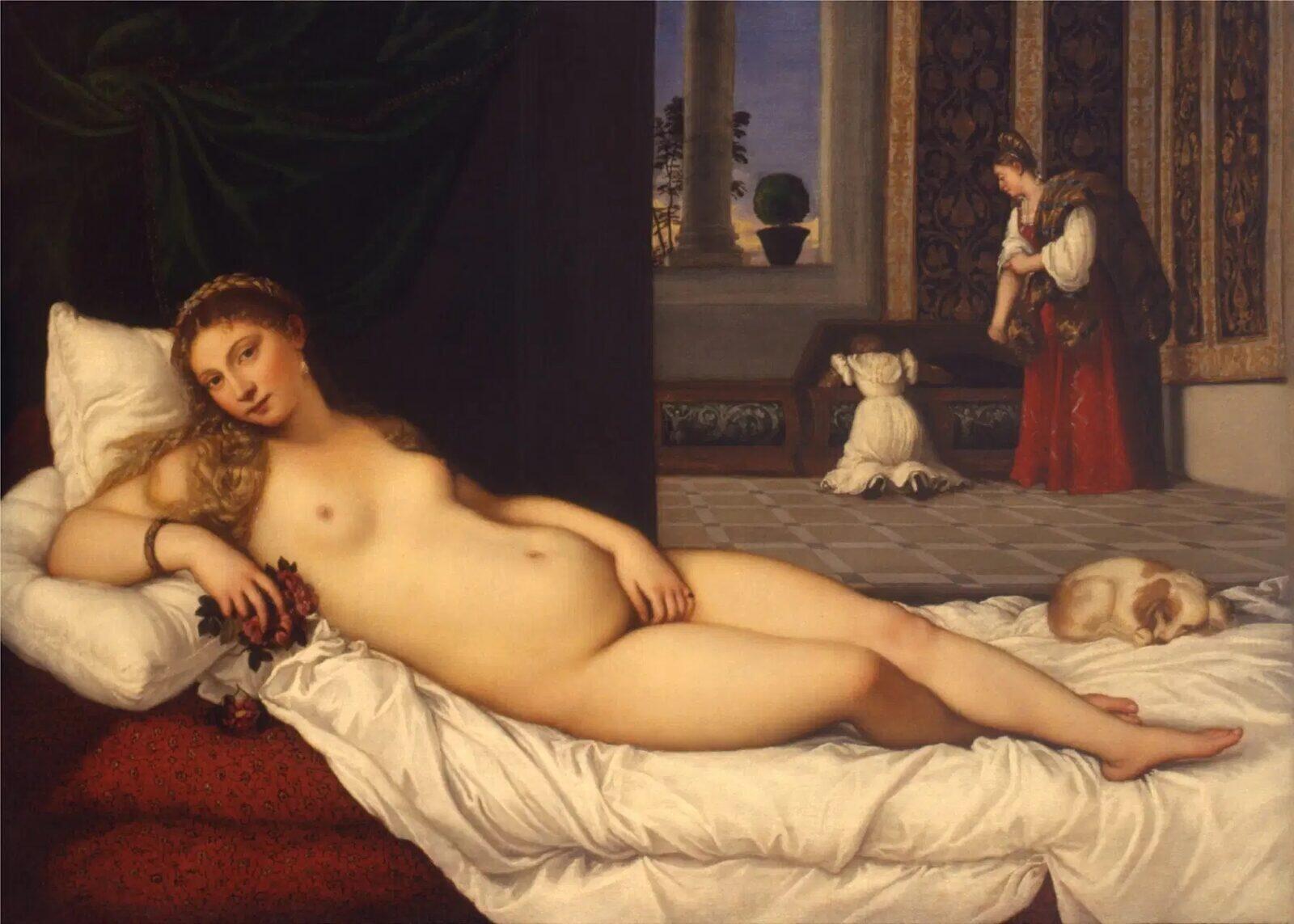
Venus of Urbino (1538), Flora (ca. 1515), Concert (attributed) – book 3 – 5 days ahead, longer for weekends
The Venus of Urbino hangs in the Titian room on the second floor (rooms 83 – 85 in the current layout). Commissioned by Guidobaldo II della Rovere, it remains the most influential reclining nude in European painting. The Flora is nearby. Timed entry is mandatory; early morning slots (8:15 – 9:00) are least crowded.
Book Uffizi tickets |
Uffizi guided tour
Galleria Palatina (Palazzo Pitti), Florence
Portrait of Pietro Aretino (1545), La Bella (ca. 1536), Mary Magdalene (ca. 1533) – book 2 – 3 days ahead
The Galleria Palatina on the first floor of Palazzo Pitti displays paintings in their historical salon-style hang. The Portrait of Pietro Aretino is in the Sala di Apollo. La Bella and the Mary Magdalene are in adjacent rooms. The collection also includes the Concert (now sometimes attributed to Giorgione). Combined Pitti + Boboli tickets are available.
Book Palazzo Pitti tickets
Museo del Prado, Madrid
Over 40 paintings, including Charles V at Mühlberg (1548), Danaë (1553), Bacchanal of the Andrians (1523 – 1526) – book 1 – 2 days ahead
The Prado holds the world's largest Titian collection, built from the Spanish royal collection of Philip II. Key rooms: rooms 24 – 29 (first floor, south wing) display the equestrian Charles V, the Worship of Venus, Bacchanal of the Andrians, and Venus with an Organist. Rooms 41 – 44 hold additional portraits and devotional works. The late Self-Portrait (ca. 1567) and the unfinished Entombment of Christ are also here. Allow at least two hours for Titian alone.
Book Museo del Prado tickets |
Prado guided tour
Kunsthistorisches Museum, Vienna
Ecce Homo (1543), Nymph and Shepherd (ca. 1570), Bravo (ca. 1520), Girl in a Fur (ca. 1535) – book online to skip queues
Vienna's Kunsthistorisches Museum holds works from the Habsburg collections in rooms on the first floor (Gemäldegalerie, Saal I – IV). The Nymph and Shepherd, one of Titian's most mysterious late works, is especially worth seeking out. The museum also displays Jacopo Strada's portrait (1567 – 1568), a sharp psychological study. Nearby in the same building: major works by Veronese and Tintoretto for comparison.
Book Kunsthistorisches Museum tickets
National Gallery, London
Bacchus and Ariadne (1520 – 1523), Diana and Actaeon (1556 – 1559, shared with Edinburgh), Noli me tangere (ca. 1514) – free entry, no booking needed
Bacchus and Ariadne hangs in room 10, one of the most vivid color compositions in European painting. The blue of Ariadne's sky, the orange of the clashing drapery, and the gold of the leopard skins are best seen in person. The Diana and Actaeon (co-owned with the National Gallery of Scotland) alternates display between London and Edinburgh. Noli me tangere is in the same wing. Free admission; check the website for temporary loans.
Book National Gallery guided tour
Museo di Capodimonte, Naples
Danaë (1544 – 1545), Portrait of Pope Paul III (1543), Pope Paul III and His Grandsons (1546) – book 1 – 2 days ahead
Capodimonte holds the original Danaë, painted in Rome for Cardinal Alessandro Farnese (the later versions in Madrid and Vienna followed this prototype). The papal portraits are among Titian's most penetrating character studies. All three hang in the Farnese Collection rooms on the second floor.
Book Museo di Capodimonte tickets
Galleria Borghese, Rome
Sacred and Profane Love (ca. 1514), Venus Blindfolding Cupid (ca. 1565) – mandatory timed entry, book 1 – 2 weeks ahead
Sacred and Profane Love is in Room XX on the ground floor. It is one of Titian's most debated early works, with a composition divided between a clothed and a nude female figure at a sarcophagus fountain. Each Borghese visit is limited to two hours; arrive promptly for your slot. The Venus Blindfolding Cupid (upstairs) represents the late style.
Book Galleria Borghese reserved entry |
Borghese guided tour
National Gallery of Scotland, Edinburgh
Diana and Actaeon (1556 – 1559, shared with London), Diana and Callisto (1556 – 1559), Three Ages of Man (ca. 1512) – free entry
Edinburgh holds two of the six poesie Titian painted for Philip II. Both Diana and Actaeon and Diana and Callisto rotate with the National Gallery London (check which is currently displayed before visiting). The Three Ages of Man, an early pastoral work, is also here. Free admission.
National Gallery of Scotland official site
Gemäldegalerie, Berlin
Venus with the Organ Player (ca. 1550), Self-Portrait (ca. 1562)
Berlin's Gemäldegalerie holds a strong group of Venetian paintings. Titian's Venus with the Organ Player is a variant of the Madrid version, displayed alongside works by Giorgione and Veronese in the Italian wing.
Book Gemäldegalerie Berlin tickets
Santa Maria della Salute, Venice
St. Mark Enthroned with Saints (ca. 1510), ceiling paintings in the sacristy – small sacristy fee, no advance booking
The sacristy of the Salute holds a group of early Titian ceiling canvases (Cain and Abel, Sacrifice of Isaac, David and Goliath) and the St. Mark Enthroned altarpiece. These are among the earliest attributable works. The sacristy is often uncrowded. Open daily 9:00 – 12:00 and 15:00 – 17:30.
Chiesa di San Salvador, Venice
Annunciation (ca. 1560 – 1566), Transfiguration (ca. 1560) – free entry
Two late altarpieces, both showing Titian's characteristic loose brushwork. The Annunciation on the right wall is signed "TITIANUS FECIT FECIT" (the double signature is original and deliberate). San Salvador is on the Mercerie, a 10-minute walk from Rialto.