ⓘ Opening hours and admission prices listed on this page are indicative and subject to change. Always verify current information on the official website of each venue before your visit.
Galleria Borghese
Ground floor, Rooms I–IV – Book 3–4 weeks ahead for weekends
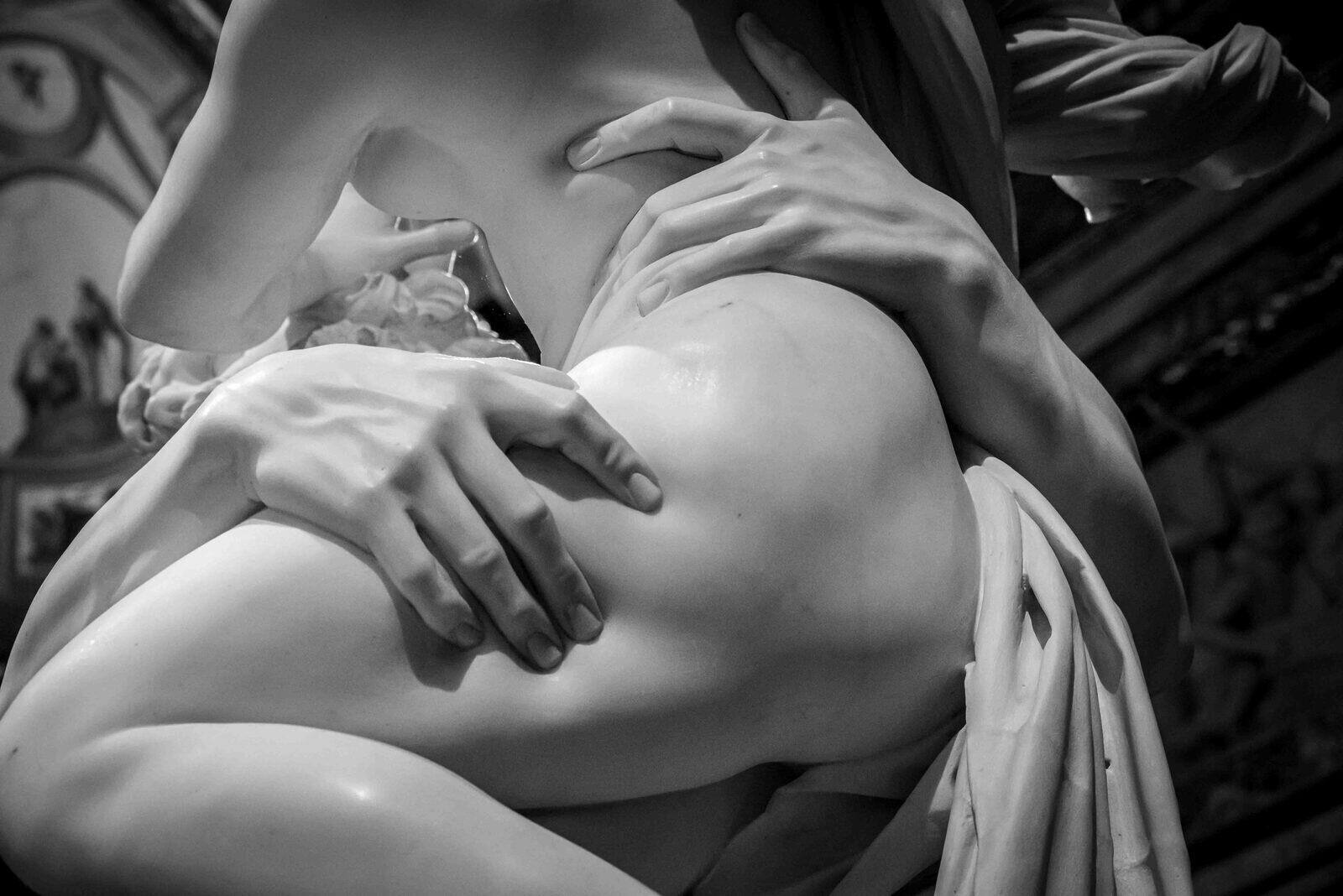
The four early marble groups commissioned by Cardinal Scipione Borghese are all on the ground floor: Aeneas, Anchises, and Ascanius (1618–19, Room VI), The Rape of Proserpina (1621–22, Room IV), Apollo and Daphne (1622–25, Room III), and David (1623–24, Room II). Each sculpture was designed for its specific room and sightline. The gallery also holds Bernini's early Truth Unveiled by Time (c. 1646–52) and the busts of Scipione Borghese (Room XIV, upper floor). Entry is strictly timed: two-hour sessions, maximum 360 visitors, no walk-ins. Sessions run at 9:00, 11:00, 13:00, 15:00, and 17:00 (Tuesday–Sunday; closed Mondays).
Book Galleria Borghese reserved entry |
Book a guided tour
St. Peter's Basilica and Square (Vatican)
Free entry to basilica – Expect security queues of 20–45 min
Bernini's largest works are concentrated here. The Baldachin (1623–34), a 29-meter bronze canopy over the papal altar, dominates the crossing. The Cathedra Petri (1657–66), a gilded-bronze throne with stained-glass dove, fills the apse. The Tomb of Urban VIII (1627–47) is in the left apse niche; the Tomb of Alexander VII (1671–78), with its polychrome marble drapery and skeleton holding an hourglass, is in the south transept passage. Outside, the elliptical Colonnade of St. Peter's Square (1656–67) is Bernini's largest architectural work: 284 columns in four rows. Arrive before 8:00 for the shortest security lines. The basilica is open daily 7:00–18:30 (18:00 in winter).
Piazza Navona: Fontana dei Quattro Fiumi
Open-air, free access at all hours
The Fountain of the Four Rivers (1648–51) was commissioned by Pope Innocent X and sits at the center of Piazza Navona, directly in front of Borromini's Sant'Agnese in Agone. The four allegorical figures represent the Nile, Ganges, Danube, and Río de la Plata, arranged around a hollow travertine rock supporting an Egyptian obelisk. The fountain is best observed early morning (before 9:00) or after dinner, when the piazza empties and you can walk around all four sides. Bernini also designed the smaller Fontana del Moro at the piazza's south end.
Santa Maria della Vittoria: Cornaro Chapel
Free entry – Open daily 7:00–12:00, 15:30–19:00
The Ecstasy of Saint Teresa (1647–52) occupies the left transept chapel, designed as a complete theatrical environment. The sculpture of Teresa and the angel sits within a convex aedicule, lit by a hidden window above. On the lateral walls, sculpted members of the Cornaro family watch from opera-like balconies. The floor pavement shows inlaid skeletons. The chapel is small; visit before 10:00 or after 16:00 to avoid tour groups. The church is on Via XX Settembre, a 5-minute walk from Piazza della Repubblica (Metro A, Repubblica station).
Santa Maria del Popolo: Chigi Chapel
Free entry – Also contains Caravaggio's Cerasi Chapel
Bernini completed the Chigi Chapel (originally designed by Raphael in 1513–16) for Pope Alexander VII in the 1650s–60s. He added two sculptures: Daniel and the Lion and Habakkuk and the Angel, placed in diagonal niches so they interact across the space. Bernini also modified the chapel's pavement and the pyramid-shaped wall tombs. The same church contains Caravaggio's Conversion of Saint Paul and Crucifixion of Saint Peter in the Cerasi Chapel (left transept), making this one of Rome's most efficient art stops. Located at the north end of Piazza del Popolo (Metro A, Flaminio). Church hours: Monday–Saturday 7:15–12:30, 16:00–19:00; Sunday 7:30–13:30, 16:30–19:30.
Palazzo Barberini
Galleria Nazionale d'Arte Antica – Also holds Caravaggio, Raphael, Lippi
Bernini contributed to the architecture of the palace itself (with Borromini and Maderno) and designed the oval staircase on the right wing. The palace houses two Bernini busts: Portrait of Urban VIII and preparatory works related to the Barberini commissions. The main draw for Bernini scholars is the building as an architectural document of the Urban VIII era. The Galleria also holds Caravaggio's Judith Beheading Holofernes and Raphael's La Fornarina. Open Tuesday–Sunday, 10:00–18:00.
Book Palazzo Barberini tickets |
Book a guided tour
Ponte Sant'Angelo
Open-air, free access – 10 min walk from Piazza Navona
Bernini designed ten angels holding instruments of the Passion for the bridge leading to Castel Sant'Angelo (1667–71). He personally carved the Angel with the Superscription and the Angel with the Crown of Thorns, but Pope Clement IX judged them too beautiful for outdoor exposure; the originals are now inside Sant'Andrea delle Fratte (Via di Sant'Andrea delle Fratte, near Piazza di Spagna). The copies on the bridge were executed by Bernini's workshop. The bridge is best visited in combination with Castel Sant'Angelo.
Book Castel Sant'Angelo tickets
Piazza Barberini: Fontana del Tritone
Open-air, free access
The Fontana del Tritone (1642–43) stands at the center of the piazza: a muscular Triton blowing a conch shell, supported by four dolphins and the Barberini bee coat of arms. Commissioned by Urban VIII, it was one of the first fountains in Rome to abandon the traditional basin-and-pillar format. At the corner of Via Veneto, the smaller Fontana delle Api (Fountain of the Bees, 1644) is also by Bernini. Piazza Barberini is served by Metro A (Barberini station) and is a natural waypoint between the Cornaro Chapel (10 min walk north) and the Trevi Fountain area.