City page

Paris Art Guide

Paris holds the largest concentration of Western art in Europe, spread across more than fifty museums, dozens of historic churches, and centuries of architectural accumulation. The Louvre alone contains over 35,000 works on display. The Musée d'Orsay houses the world's most important collection of Impressionist and Post-Impressionist painting. The Orangerie preserves Monet's Nymphéas in the rooms he designed for them. And that is before counting the Picasso Museum, Pompidou, Marmottan, and the great churches from Notre-Dame to Sainte-Chapelle.

This page maps all major art locations in Paris with practical booking links, specific artworks to look for, and cluster-based itineraries to help you plan each day by neighbourhood rather than by random attraction.

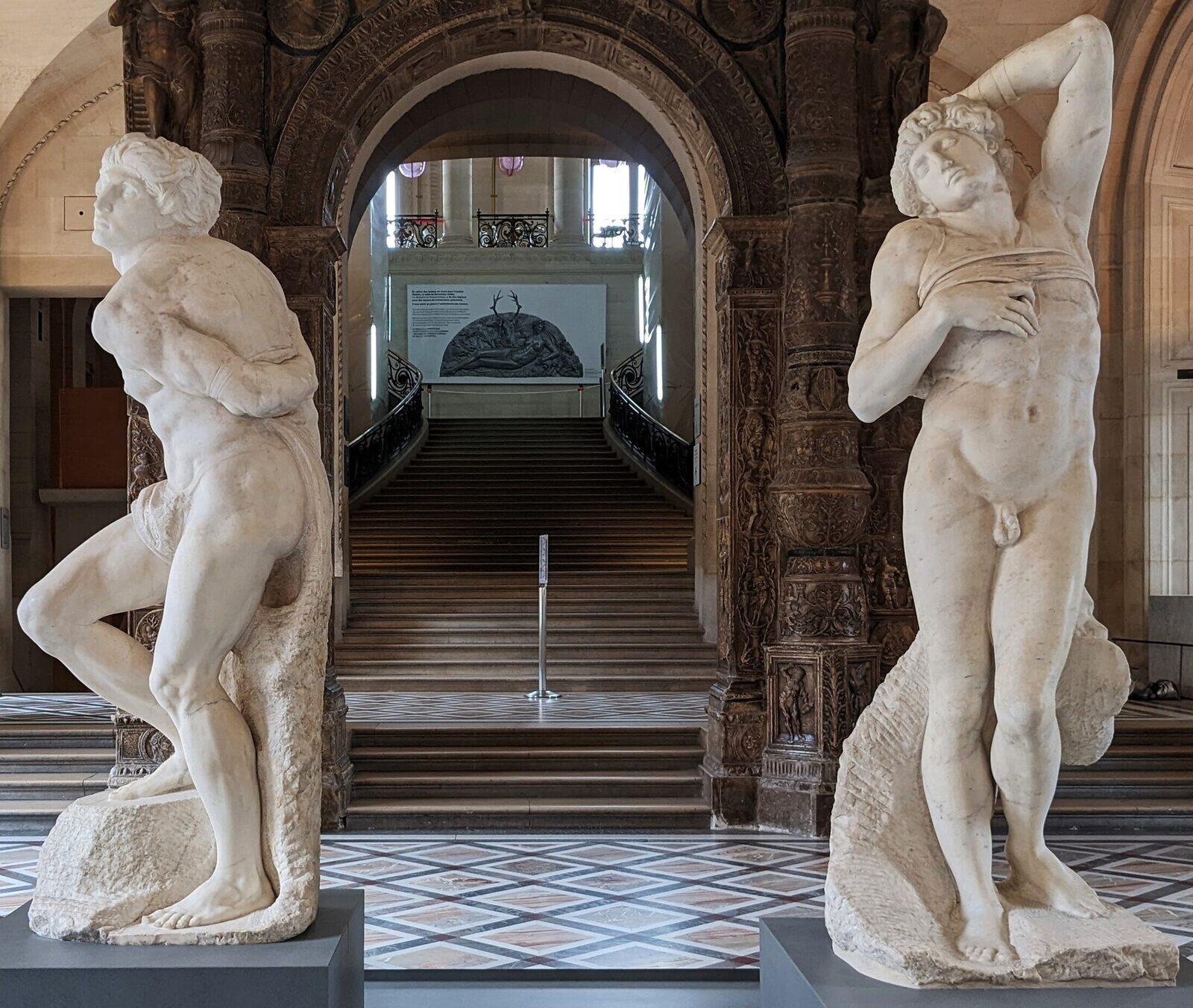
Michelangelo's Dying Slave at the Louvre, Paris

Where to see art in Paris

Tap to activate map

Major museums in Paris

ⓘ Opening hours and admission prices listed on this page are indicative and subject to change. Always verify current information on the official website of each venue before your visit.

Musée du Louvre

Leonardo, Veronese, Delacroix, Vermeer, Caravaggio – book at least 3–5 days in advance (timed entry mandatory)

The Louvre's painting collection spans the Denon and Richelieu wings. In the Denon Wing, first floor: the Grande Galerie holds Leonardo's Virgin of the Rocks (c. 1483–1486), La Belle Ferronnière, Saint John the Baptist, and The Virgin and Child with Saint Anne; the Salle des États contains the Mona Lisa alongside Veronese's Wedding at Cana (1563). Also in the Denon Wing: Géricault's Raft of the Medusa (Room 700) and Delacroix's Liberty Leading the People (Room 700). The Richelieu Wing, second floor, holds the Northern European collection, including Vermeer's Lacemaker and works by Rubens in the Galerie Médicis (24 large canvases of the Marie de' Medici cycle). Italian sculpture (ground floor, Denon) includes Michelangelo's two Slaves (c. 1513–1516) and Canova's Psyche Revived by Cupid's Kiss. Open daily except Tuesday, 9:00–18:00 (21:00 on Wednesdays and Fridays). First-entry slots at 9:00 sell out first.

Book Louvre guided tour tickets

Musée d'Orsay

Monet, Renoir, Degas, Van Gogh, Cézanne – book 2–3 days ahead, less crowded late afternoon

The former Gare d'Orsay railway station holds the world's richest Impressionist and Post-Impressionist collection. Level 5 (top floor) is the essential destination: Monet's Rouen Cathedral series, Renoir's Bal du moulin de la Galette (1876), Degas's ballet scenes, and Caillebotte's Paris Street; Rainy Day. Level 2 holds Van Gogh's Bedroom in Arles (1889), Starry Night over the Rhône (1888), and his Self-Portrait (1889), alongside Cézanne's Card Players. The ground floor features Courbet's The Origin of the World and Manet's Olympia (1863). Open Tuesday through Sunday, 9:30–18:00 (21:45 on Thursdays). A 10-minute walk from the Orangerie along the Left Bank.

Book Musée d'Orsay ticketsBook d'Orsay guided tour

Musée de l'Orangerie

Monet's Nymphéas, Walter-Guillaume Collection – book 1–2 days ahead

Two oval rooms on the ground floor house Monet's eight monumental Nymphéas (Water Lilies) panels, installed according to the artist's specifications in 1927. The natural light and curved walls create an immersive experience unlike any other presentation of his work. The basement level holds the Walter-Guillaume Collection: key works by Cézanne (including Apples and Biscuits), Renoir (Young Girls at the Piano), Modigliani (portraits), Soutine, Picasso (The Female Bathers), and Henri Rousseau (The Snake Charmer). Located in the Tuileries Garden at Place de la Concorde. Open Wednesday through Monday, 9:00–18:00. Start here early, then walk to d'Orsay.

Book Musée de l'Orangerie tickets

Musée Picasso Paris

Over 5,000 Picasso works – book 1–2 days ahead

Housed in the 17th-century Hôtel Salé in the Marais district, the museum holds the largest public Picasso collection in the world. Key works include the Self-Portrait from the Blue Period (1901), the proto-Cubist paintings from 1906–1908, the Celestina (1904), Man with a Guitar (1911), and the large Massacre in Korea (1951). The collection also includes sculptures, ceramics, and Picasso's own personal art collection (works by Cézanne, Matisse, Degas, and Rousseau that he kept until his death). Chronological layout across three floors. Open Tuesday through Friday 10:30–18:00, weekends 9:30–18:00. About 15 minutes on foot from the Pompidou Centre.

Book Musée Picasso Paris tickets

Musée Marmottan Monet

Impression, Sunrise (1872) and 100+ Monet paintings – rarely crowded, book 1 day ahead

Located in the residential 16th arrondissement near the Bois de Boulogne, this former hunting lodge holds the painting that named Impressionism: Monet's Impression, Sunrise (1872). The lower-level gallery displays over 100 Monet canvases, including late Water Lilies, the Japanese Bridge series, and views of London and Rouen. Upper floors hold Berthe Morisot's largest collection anywhere, plus works by Renoir, Sisley, Pissarro, and Gauguin. A less visited museum that rewards the trip across town. Open Tuesday through Sunday, 10:00–18:00 (21:00 on Thursdays). Metro: La Muette (line 9).

Book Musée Marmottan Monet tickets

Centre Pompidou

Matisse, Kandinsky, Duchamp, Brancusi – check temporary closure schedule for 2025–2030 renovation

The Pompidou holds Europe's largest modern and contemporary art collection (over 120,000 works, with roughly 600 on display at any time). Level 5 covers 1905–1960: Matisse's large cut-outs, Kandinsky's major abstractions (he donated his studio contents), Duchamp's Fountain replica, Brancusi's sculptures (reconstructed studio visible outside the building for free), and major Cubist works by Braque and Picasso. Level 4 covers 1960 to today. The building is scheduled for a major renovation starting late 2025 (check current access before visiting). Located in the Beaubourg neighbourhood, 15 minutes on foot from the Musée Picasso.

Visit Centre Pompidou official site

Musée Jacquemart-André

Italian Renaissance and Dutch masters – an overlooked gem on the Boulevard Haussmann

One of the most underrated museums in Paris, and one of the few places in the city where you can stand in front of significant Italian Renaissance painting without a crowd. The collection assembled by Édouard André and Nélie Jacquemart in their 19th-century hôtel particulier on Boulevard Haussmann covers an exceptional range: Botticelli, Paolo Uccello, Carlo Crivelli, Francesco del Cossa, Mantegna, Donatello, Bernardino Luini, and Alesso Baldovinetti — names that rarely appear together outside Florence, Ferrara, or the National Gallery in London. The hanging is dense and the rooms are intimate, which makes this a genuinely different experience from the grand museum model. Allow 90 minutes and visit on a weekday morning to have it largely to yourself.

Book Musée Jacquemart-André tickets
Main Paris art clusters

Cluster 1: Louvre – Tuileries – Orangerie

The historic centre and the Right Bank museums

Start at the Orangerie (9:00 AM, Monet's Nymphéas), then walk through the Tuileries Garden to the Louvre (allow at least 3–4 hours). The Musée des Arts Décoratifs sits inside the Louvre complex on the Rue de Rivoli side. The Palais Royal and Sainte-Chapelle (stained glass, c. 1248) are both within a 10-minute walk. Practical tip: do the Louvre and Orangerie on separate mornings if you want to avoid fatigue.

Cluster 2: Left Bank – d'Orsay – Saint-Germain

Musée d'Orsay, Delacroix, and Left Bank churches

Musée d'Orsay anchors this cluster. From there, walk 8 minutes south to the Musée Delacroix (Place de Furstemberg), which preserves the painter's last studio and several late works. Continue 5 minutes to Saint-Sulpice for Delacroix's chapel murals (Jacob Wrestling the Angel, 1855–1861). Saint-Germain-des-Prés, Paris's oldest church (6th century), is a 2-minute walk away. The Musée de Cluny (medieval art, Lady and the Unicorn tapestries) is a 15-minute walk east.

Cluster 3: Marais – Beaubourg

Picasso Museum, Pompidou, and the Marais quarter

The Musée Picasso and Centre Pompidou are 15 minutes apart on foot through the Marais. Combine them in a single afternoon (Picasso first, as it closes earlier). The Musée Carnavalet (free, Paris history, with period rooms and paintings) is between them. The Archives Nationales and Hôtel de Soubise (Rococo interiors) are two blocks north of Picasso. Practical tip: the Marais is compact enough for art, lunch, and a second museum in one visit.

Cluster 4: Île de la Cité – sacred Paris

Notre-Dame, Sainte-Chapelle, and the island churches

Sainte-Chapelle's 13th-century stained glass windows (1,113 panels, 15 metres tall) are one of the most important surviving works of Gothic art. Notre-Dame, reopened after restoration in December 2024, sits 200 metres east. Cross the bridge south to reach Saint-Séverin (15th-century flamboyant Gothic) and Saint-Julien-le-Pauvre. Practical tip: visit Sainte-Chapelle at opening (9:00 AM) to avoid the long queue; buy a combined ticket with the Conciergerie next door.

Cluster 5: Montmartre

Sacré-Coeur and the artists' neighbourhood

Montmartre's importance is more historical than museological: this is where Renoir, Toulouse-Lautrec, Van Gogh, and Picasso worked between the 1870s and 1910s. The Musée de Montmartre (12 Rue Cortot) preserves Renoir's former studio and a recreation of the gardens he painted. The Bateau-Lavoir, where Picasso painted Les Demoiselles d'Avignon (1907), is nearby at 13 Place Émile-Goudeau (exterior only). The Basilica of Sacré-Coeur offers a free panoramic view of Paris from 130 metres. Best visited in the morning before crowds arrive.

Practical note

Booking and Paris Museum Pass

The Paris Museum Pass (2, 4, or 6 days) covers the Louvre, d'Orsay, Orangerie, Picasso, Sainte-Chapelle, and 50+ other sites, but you still need a timed reservation for the Louvre. It does not cover the Marmottan Monet or Pompidou temporary exhibitions. For the Louvre alone, a guided tour with skip-the-line entry is often the most efficient way to see the highlights. Book a Louvre guided tour.

Explore the artists who defined Paris

Leonardo Art Map

The Louvre holds five of Leonardo's roughly fifteen surviving paintings, the largest group in any museum. After locating the Mona Lisa and the Virgin of the Rocks in Paris, use the Leonardo page to trace his works in Florence, Milan, London, and Kraków.

Monet Art Map

Monet's work is spread across three major Paris museums: the Nymphéas at the Orangerie, the Rouen Cathedral series at d'Orsay, and Impression, Sunrise at the Marmottan. The Monet page maps all locations including Giverny, 75 km northwest of Paris, where his house and gardens are open April through November.

Modigliani Art Map

Modigliani lived and worked in Montparnasse from 1906 until his death in 1920. Portraits and nudes by Modigliani are held at the Orangerie (Walter-Guillaume Collection) and the Musée d'Art Moderne de la Ville de Paris. Use the Modigliani page to find his works across Paris, London, and New York.

Frequently asked questions

Do I need to book the Louvre in advance?

Yes. Timed-entry tickets are mandatory. Book at least 3–5 days ahead for weekdays and 1–2 weeks for weekends and school holidays. First-entry slots (9:00 AM) sell out fastest. A guided tour with skip-the-line access is often the most efficient option.

How many days do I need for art in Paris?

A minimum of three full days: one for the Louvre (at least 4 hours), one for d'Orsay plus the Orangerie, and one for the Picasso Museum and Pompidou. Add a fourth day for churches (Sainte-Chapelle, Saint-Sulpice, Notre-Dame) and a fifth day if visiting Giverny.

Where are the Impressionist paintings in Paris?

The main collection is at the Musée d'Orsay (level 5). Monet's Nymphéas cycle is at the Orangerie. Impression, Sunrise (the painting that named the movement) is at the Marmottan Monet in the16th arrondissement.

Paris: too much to see without a system.

The density of major collections in Paris is unmatched. The map helps you understand what is where, how the institutions relate spatially, and which clusters reward a dedicated half-day rather than a rushed hour.