ⓘ Opening hours and admission prices listed on this page are indicative and subject to change. Always verify current information on the official website of each venue before your visit.
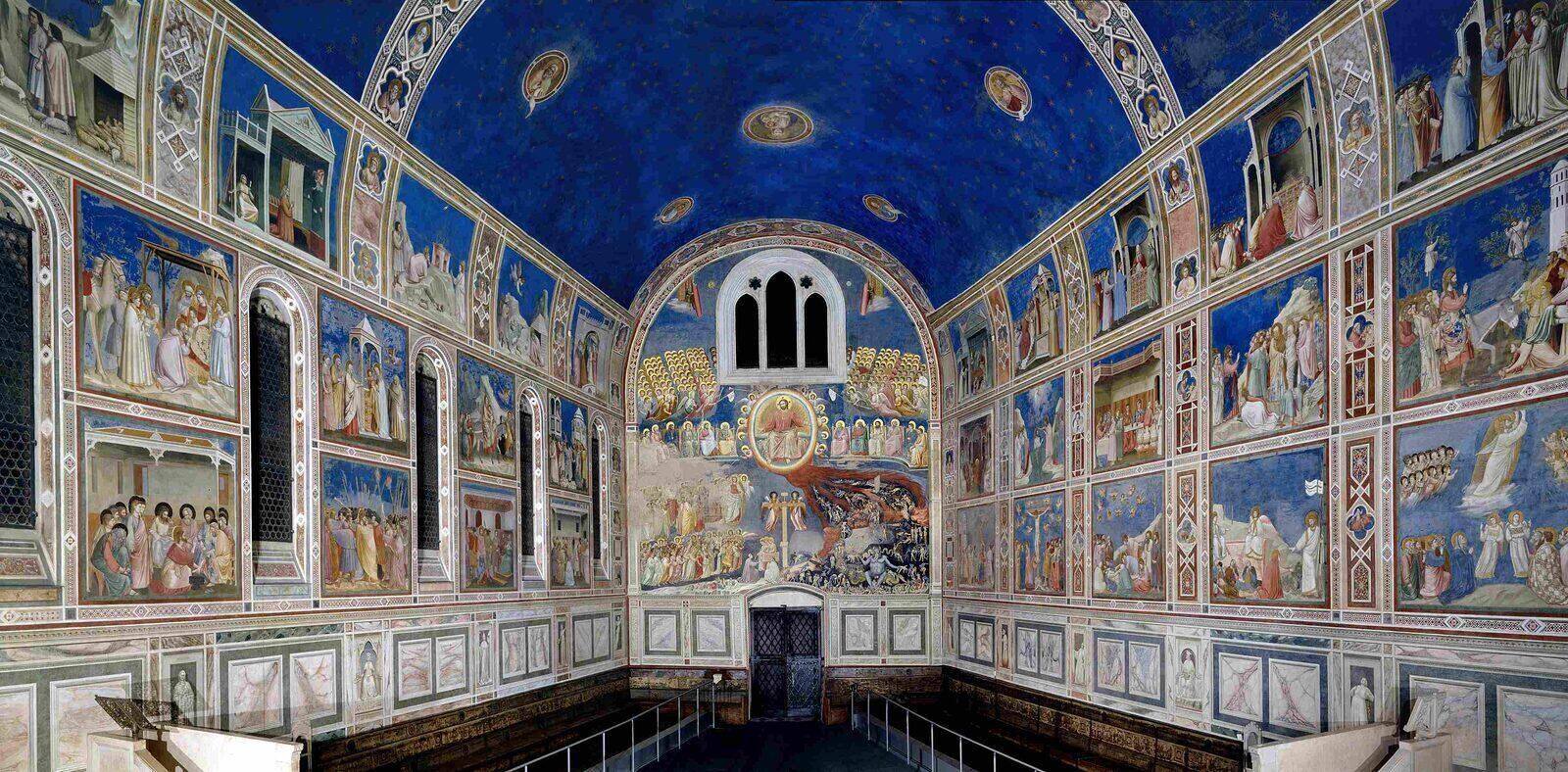
Scrovegni Chapel (Cappella degli Scrovegni)
Giotto, 1303–1305 fresco cycle – booking mandatory, reserve 2–4 weeks ahead
Giotto's complete fresco cycle covers the entire interior: 38 scenes from the lives of Joachim and Anna, the Virgin, and Christ, plus the monumental Last Judgment on the entrance wall. Visits last 15 minutes (plus 15 minutes in the climate-controlled antechamber). Maximum 25 visitors per slot. Open Tuesday to Sunday, 9:00–19:00. Evening visits sometimes available in summer. The chapel is inside the Giardini dell'Arena, adjacent to the Musei Civici Eremitani (combined ticket available).
Book Scrovegni Chapel & Musei Civici tickets
Musei Civici agli Eremitani
Pinacoteca, archaeological museum – combined ticket with Scrovegni Chapel
The pinacoteca on the upper floor holds works by Guariento di Arpo (polyptych panels and Angels series), Giotto's Crucifix from the Scrovegni Chapel, a fine Crucifixion by Giorgione (attributed), and paintings by Tintoretto, Veronese, and Tiepolo. The ground floor houses the archaeological collection with Roman artifacts from Patavium. Directly adjacent to the Scrovegni Chapel; plan 60–90 minutes.
Musei Civici Eremitani (official site)
Basilica of Saint Anthony (Basilica del Santo)
Donatello bronzes, Altichiero frescoes – free entry to basilica, donation for chapels
The high altar holds Donatello's bronze Crucifix, the Madonna with Child, and six bronze saints (1444–1450), plus four large narrative reliefs depicting miracles of Saint Anthony. Outside on the piazza stands Donatello's Equestrian Monument of Gattamelata (1453), the first large-scale equestrian bronze since antiquity. Inside, the Cappella di San Giacomo contains Altichiero da Zevio's fresco cycle of the Life of Saint James (c. 1379). The Cappella del Beato Luca Belludi has frescoes by Giusto de' Menabuoi. The basilica is open daily 6:15–19:45 (shorter hours in winter). Located 10 minutes on foot south of the Scrovegni Chapel.
Baptistery of Padua Cathedral
Giusto de' Menabuoi, c. 1375–1378 – separate ticket required
The entire interior is covered with Giusto de' Menabuoi's fresco cycle: scenes from Genesis, the life of Christ, and the Apocalypse, with the immense Paradise filling the dome. The polyptych altarpiece on the altar is also by Giusto. Located in Piazza Duomo, 5 minutes west of the Palazzo della Ragione. Open daily 10:00–18:00. Allow 30 minutes.
Church of the Eremitani (Chiesa degli Eremitani)
Mantegna, Ovetari Chapel (partial reconstruction) – free entry
Andrea Mantegna's Ovetari Chapel frescoes (1448–1457) were mostly destroyed by bombing in 1944. The two surviving panels, Assumption of the Virgin and Martyrdom of Saint Christopher, were reinstalled alongside a 2006 reconstruction from recovered fragments. The church also contains frescoes by Guariento. Located immediately next to the Musei Civici Eremitani. Open Monday to Saturday, 8:00–18:00, Sunday 10:00–13:00.
Palazzo della Ragione
Nicolò Miretto and Stefano da Ferrara, astrological fresco cycle – ticket required
The upper hall (the Salone) is one of the largest medieval halls in Europe (81m long). The walls are covered with an astrological fresco cycle (15th century, replacing a lost Giotto cycle). A wooden horse attributed to Annibale Capodilista (15th century) stands inside. Located between Piazza delle Erbe and Piazza della Frutta. Open Tuesday to Sunday, 9:00–18:00 (November–January until 18:00). Three minutes from the Baptistery.
Oratorio di San Giorgio
Altichiero da Zevio, fresco cycle c. 1379–1384 – ticket required
Complete fresco cycle by Altichiero: scenes from the lives of Christ, Saint George, Saint Catherine, and Saint Lucy. One of the best-preserved late 14th-century fresco ensembles in Northern Italy. Located next to the Basilica of Saint Anthony, on the south side of the piazza. Open daily 9:00–12:30 and 14:30–17:00 (summer until 18:00).
Scuola del Santo
Titian, early frescoes (1511) – ticket required
Three frescoes by the young Titian depicting Miracles of Saint Anthony (1511): the Miracle of the Jealous Husband, the Miracle of the Newborn Child, and the Miracle of the Irascible Son. These are among Titian's earliest known works. Located upstairs, adjacent to the Basilica of Saint Anthony and the Oratorio di San Giorgio. Same ticket covers both. Allow 20 minutes.