City page

Milan Art Guide

Milan holds Leonardo's Last Supper, one of the most consequential wall paintings in existence, alongside the Pinacoteca di Brera (Mantegna, Raphael, Caravaggio), the Pinacoteca Ambrosiana (Caravaggio's Basket of Fruit, Leonardo's Portrait of a Musician), and Michelangelo's unfinished Rondanini Pietà in the Castello Sforzesco. This page maps every major museum, church, and fresco site across the city to help you build a practical itinerary.

Milan Duomo and cityscape detail

Where to see art in Milan

Tap to activate map

Where to book: Milan museums and sites

ⓘ Opening hours and admission prices listed on this page are indicative and subject to change. Always verify current information on the official website of each venue before your visit.

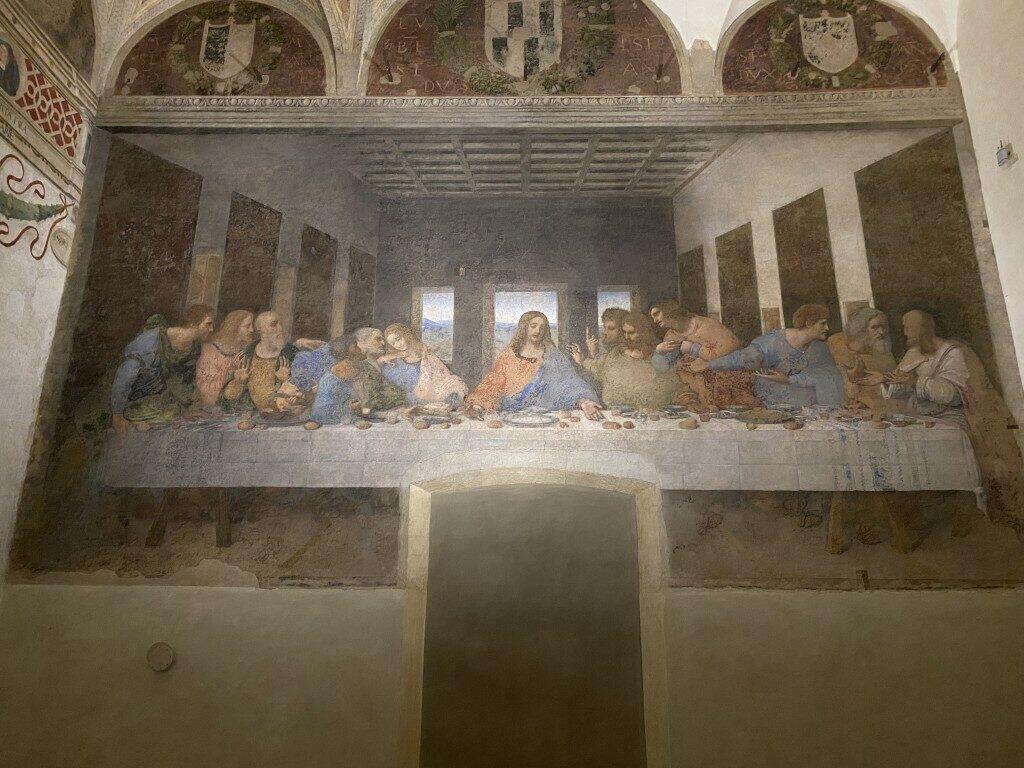
Cenacolo Vinciano (Leonardo's Last Supper)

Santa Maria delle Grazie, Piazza di Santa Maria delle Grazie 2 – book 6–8 weeks ahead

Leonardo's Last Supper (1495–1498) covers the north wall of the refectory in the Dominican convent attached to Santa Maria delle Grazie. Visits are strictly timed: 15 minutes per group, maximum 25 people. The refectory also contains Donato Montorfano's Crucifixion (1495) on the opposite wall. Entry is from Piazza Santa Maria delle Grazie. Closed Mondays. A guided tour gives you priority access and context on Leonardo's experimental secco technique.

Book Last Supper guided tour

Pinacoteca di Brera

Via Brera 28 – allow 2–3 hours – closed Mondays

One of Italy's greatest painting collections. Key works: Mantegna's Dead Christ (c. 1480, Room VI), Raphael's Marriage of the Virgin (1504, Room XXIV), Piero della Francesca's Brera Madonna (c. 1472, Room XXIV), Caravaggio's Supper at Emmaus (1606, Room XXIX), Giovanni Bellini's Pietà (c. 1460, Room VI), Gentile and Giovanni Bellini's Preaching of St. Mark (Room VII), and Hayez's The Kiss (1859, Room XXXVII). Online booking recommended for weekends and peak season. The museum sits above the Accademia di Belle Arti; allow time for the courtyard with Canova's bronze Napoleon.

Book Pinacoteca di Brera guided tour

Pinacoteca Ambrosiana

Piazza Pio XI 2 – near the Duomo – allow 1.5–2 hours

Founded by Cardinal Federico Borromeo in 1618. The collection includes Caravaggio's Basket of Fruit (c. 1599, Room 1), Leonardo's Portrait of a Musician (c. 1485, Room 2), Raphael's preparatory cartoon for The School of Athens (Room 5), Titian's Adoration of the Magi, Bramantino's Madonna and Child, and Luini's frescoes. The adjoining Biblioteca Ambrosiana houses Leonardo's Codex Atlanticus (selected folios on rotating display). A 10-minute walk from the Duomo. Book online to skip the queue.

Book Pinacoteca Ambrosiana tickets

Castello Sforzesco

Piazza Castello – museums open Tue–Sun, 10:00–17:30

The castle complex contains several museums. The Museo d'Arte Antica (ground floor) holds Michelangelo's Rondanini Pietà (c. 1552–1564) in its own dedicated room, plus medieval Lombard sculpture. The Pinacoteca del Castello (upper floor) includes works by Mantegna, Bellini, Canaletto, Antonello da Messina's Portrait of a Man, and Correggio. The Sala delle Asse preserves Leonardo's painted ceiling decoration (c. 1498, currently partially restored). A combined ticket covers all museums.

Book Castello Sforzesco ticketsGuided tour

San Maurizio al Monastero Maggiore

Corso Magenta 15 – free entry – 5-minute walk from the Last Supper

Often called "the Sistine Chapel of Milan," this former Benedictine church preserves one of the finest fresco cycles in northern Italy. Bernardino Luini painted the main wall and many side chapels (1522–1529), with additional frescoes by Boltraffio and other Leonardeschi. The dividing wall separating the public nave from the nuns' choir is entirely covered in narrative frescoes. Free entry, no booking required. Combine with the Last Supper visit on the same morning.

Sant'Ambrogio

Piazza Sant'Ambrogio 15 – free entry – closed during services

Milan's oldest church (founded 379 AD by St. Ambrose). The apse preserves 4th–8th century mosaics, and the Chapel of San Vittore in Ciel d'Oro contains 5th-century gold mosaics. The 9th-century golden altar by Vuolvinio is one of the most important Carolingian artworks in existence. The Bramante-designed Canonica cloister is adjacent. A 15-minute walk south of the Last Supper.

Museo del Novecento

Piazza del Duomo 8 – open Tue–Sun

Dedicated to 20th-century Italian art, housed in the Arengario building on Piazza del Duomo. The collection opens with Pellizza da Volpedo's Il Quarto Stato (1901) in a panoramic room facing the Duomo. Rooms include Boccioni's Futurist sculptures, Morandi's still lifes, Fontana's spatial environments (including the neon ceiling), De Chirico, Carrà, and Modigliani. No advance booking needed. A natural continuation after visiting the Duomo.
Main Milan art clusters

Leonardo core

Santa Maria delle Grazie, San Maurizio, Sant'Ambrogio

The western Corso Magenta axis: start at Santa Maria delle Grazie for the Last Supper (morning slot), walk 5 minutes to San Maurizio al Monastero Maggiore for Luini's frescoes (free), then 15 minutes south to Sant'Ambrogio for early Christian mosaics and the golden altar. The Museo Archeologico (Roman tower and mosaics) is on the same route.

Brera district

Pinacoteca di Brera, San Marco, Orto Botanico

The Brera district concentrates Milan's artistic and intellectual life. After the Pinacoteca, visit the church of San Marco (Luini frescoes, 15th-century chapels) and the Orto Botanico behind the gallery. The Biblioteca Braidense, in the same palace complex, is worth a stop. The area is a 20-minute walk northeast from the Duomo.

Duomo area

Duomo, Pinacoteca Ambrosiana, Museo del Novecento, Palazzo Reale

The Duomo itself holds Lombard Gothic sculpture, 15th-century stained glass, and the St. Bartholomew statue by Marco d'Agrate. The Pinacoteca Ambrosiana is a 10-minute walk south. Museo del Novecento and Palazzo Reale (major temporary exhibitions) face Piazza del Duomo. Half a day covers this cluster thoroughly.

Artists who shaped Milan

Leonardo Art Map

Leonardo spent nearly 20 years in Milan across two stays (1482–1499, 1506–1513), producing the Last Supper, the Sala delle Asse ceiling, the Portrait of a Musician, and the Lady with an Ermine (now in Kraków). Trace his full geography from Florence to Milan and beyond.

Michelangelo Art Map

Michelangelo worked on the Rondanini Pietà for the last nine years of his life, and left it unfinished at his death in 1564. What remains is not a failed sculpture but a different kind of object: two figures dissolved into each other, the marble thinned to near-transparency in places, the surface bearing the marks of repeated reworking and partial demolition. It is the least monumental and most intimate of his major works, displayed alone in a dedicated room at the Castello Sforzesco.

Caravaggio Art Map

Caravaggio was born in Milan (or nearby Caravaggio) and trained here under Simone Peterzano before leaving for Rome at age 21. The Ambrosiana's Basket of Fruit and Brera's Supper at Emmaus are key Milanese holdings. Follow his route south through Rome and Naples.

Read Milan on TheIntroverTraveler

Venice canal

Leonardo da Vinci's Last Supper

A detailed essay on the Last Supper's experimental secco technique, its deterioration history, the 1999 restoration, and what you actually see today in the refectory of Santa Maria delle Grazie.

FAQ

How do I book tickets for Leonardo's Last Supper?

The Last Supper requires mandatory advance booking. Slots sell out 6 to 8 weeks ahead in peak season (April through October). You can book through the official site or through a guided tour, which often includes slots that are otherwise unavailable. Book a Last Supper guided tour.

How many days do I need for art in Milan?

Two full days cover the essentials: day one for the Last Supper, San Maurizio, and the Pinacoteca Ambrosiana; day two for Pinacoteca di Brera and Castello Sforzesco. A third day allows for Sant'Ambrogio, the Museo del Novecento, and Palazzo Reale exhibitions.

What are the must-see paintings in the Pinacoteca di Brera?

Mantegna's Dead Christ (Room VI), Raphael's Marriage of the Virgin (Room XXIV), Piero della Francesca's Brera Madonna (Room XXIV), Caravaggio's Supper at Emmaus (Room XXIX), and Hayez's The Kiss (Room XXXVII). Allow 2 to 3 hours.

Is the Castello Sforzesco free to enter?

The castle courtyards are free and open daily. The museums inside (including the room with Michelangelo's Rondanini Pietà) require a ticket. Free entry to museums is available on the first and third Tuesday of each month after 14:00. Book Castello Sforzesco tickets.

Where are the Caravaggio paintings in Milan?

Two key locations: the Pinacoteca Ambrosiana holds the Basket of Fruit (c. 1599, Room 1), and the Pinacoteca di Brera has the Supper at Emmaus (1606, Room XXIX). The Ambrosiana is near the Duomo; Brera is a 20-minute walk north.

Milan, where patronage shaped visual intelligence.

If Florence represents civic Humanism and Rome papal magnificence, Milan speaks the language of strategic patronage and dynastic ambition. The Visconti and Sforza courts brought Leonardo to the city. Cardinal Borromeo built the Ambrosiana to educate artists and citizens. Napoleon reorganized Lombardy's looted art into the Brera. The results are concentrated, layered, and remarkably walkable.