ⓘ Opening hours and admission prices listed on this page are indicative and subject to change. Always verify current information on the official website of each venue before your visit.
Palazzo Ducale
Camera degli Sposi, Pisanello frescoes, Rubens altarpieces – book timed entry in advance
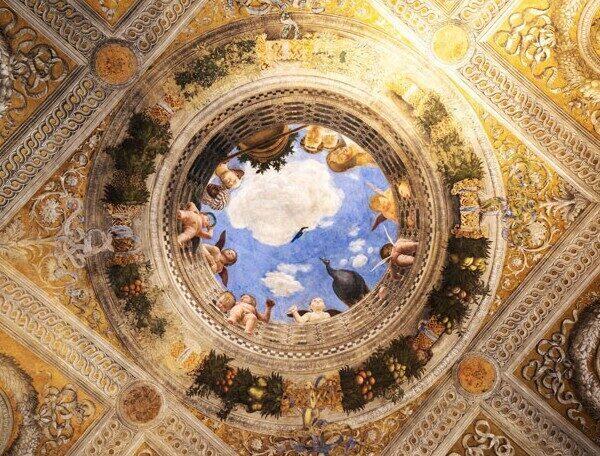
The Gonzaga residence is a sprawling complex of over 500 rooms built between the 14th and 17th centuries. The essential visit centers on three areas. First: the Camera degli Sposi (Castello di San Giorgio wing, upper floor), painted by Andrea Mantegna between 1465 and 1474 with the celebrated illusionistic ceiling oculus and the group portrait of the Gonzaga court. Access is limited to groups of 5 for approximately 10 minutes; booking well in advance is critical from spring through autumn. Second: the Sala del Pisanello (ground floor of the Corte Vecchia), with the unfinished Arthurian tournament fresco cycle by Pisanello (c. 1430s), rediscovered in the 1960s. Third: the Galleria degli Specchi and the apartments housing Peter Paul Rubens' large Adoration of the Magi triptych (c. 1604–1605), painted during his Mantuan period. Allow 2–3 hours for a full visit. The palace is closed on Mondays.
Visit Palazzo Ducale official site
Palazzo Te
Sala dei Giganti, Sala di Psiche, Giulio Romano – open Tue–Sun
Built by Giulio Romano between 1524 and 1534 as a suburban villa for Federico II Gonzaga, Palazzo Te is the most complete surviving example of Mannerist architecture and decorative painting in Italy. The two essential rooms: the Sala dei Giganti, a fully immersive fresco cycle depicting the fall of the Titans, where walls and ceiling merge to eliminate any architectural reference; and the Sala di Psiche, with its elaborate mythological banquet scenes featuring explicit content drawn from Apuleius. Also notable: the Sala dei Cavalli, with life-size portraits of the Gonzaga horses. The palace is a 20-minute walk south of Piazza Sordello. Open Tuesday to Sunday; no advance booking normally required. Allow 1.5–2 hours.
Visit Palazzo Te official site
Basilica di Sant'Andrea
Leon Battista Alberti facade, Mantegna's burial chapel, Correggio dome
Designed by Leon Battista Alberti from 1472, this is the most important church in Mantua and a landmark of Renaissance architectural theory (the monumental triumphal arch facade). Inside, the first chapel on the left aisle contains the funerary chapel of Andrea Mantegna, with his bronze bust and frescoes attributed to his workshop (the Holy Family and Baptism of Christ). The dome was frescoed by Correggio (now largely attributed to his circle). The crypt holds the Sacred Vessels (Sacri Vasi), reliquaries said to contain drops of Christ's blood. Free entry. Located on Piazza Mantegna, a 5-minute walk from Palazzo Ducale.
Museo Diocesano Francesco Gonzaga
Correggio, Mantegna-school works, liturgical objects
Housed in the former cloisters of Sant'Agnese (adjacent to Piazza Virgiliana), this museum holds a small but high-quality collection. The most notable painting is a Holy Family with Saints by Correggio and a panel attributed to Domenico Fetti. The collection of liturgical vestments and objects from Gonzaga-era churches adds historical context. Open Thursday to Sunday; check seasonal hours. Allow 45 minutes.
Rotonda di San Lorenzo
11th-century round church – fragments of Romanesque frescoes
The oldest church in Mantua (built c. 1083), located in Piazza delle Erbe at street level below the modern pavement. The interior preserves fragments of 11th–12th century frescoes on the upper gallery walls. Free entry; brief visit (15–20 minutes). A useful stop between Palazzo Ducale and Palazzo Te.
Duomo di Mantova (Cattedrale di San Pietro)
Giulio Romano interior redesign, 14th-century side chapel frescoes
Facing Piazza Sordello directly opposite Palazzo Ducale, the Duomo was rebuilt by Giulio Romano in the 1540s with a luminous white interior in a classicizing style. The side chapels retain fragments of earlier 14th-century fresco decoration. The Romanesque bell tower survives from the previous structure. Free entry.