ⓘ Opening hours and admission prices listed on this page are indicative and subject to change. Always verify current information on the official website of each venue before your visit.
Mauritshuis, The Hague
3 Vermeers including Girl with a Pearl Earring – book 1–2 weeks ahead in summer
The Mauritshuis holds Girl with a Pearl Earring (c. 1665), Diana and Her Companions, and View of Delft. The last is the only surviving outdoor cityscape by Vermeer, a work that Proust considered the most beautiful painting in the world. The museum is small (roughly 15 rooms across two floors), the Vermeer works are easy to find on the first floor, and the quality of what is here makes it the single most important stop for anyone interested in the artist.
Opening hours: Monday 13:00–18:00, Tuesday through Sunday 10:00–18:00 (Thursday until 20:00). Advance timed-entry booking strongly recommended, especially April through September. Weekend slots sell out fast.
Book tickets for the Mauritshuis
Rijksmuseum, Amsterdam
4 Vermeers including The Milkmaid – timed entry required
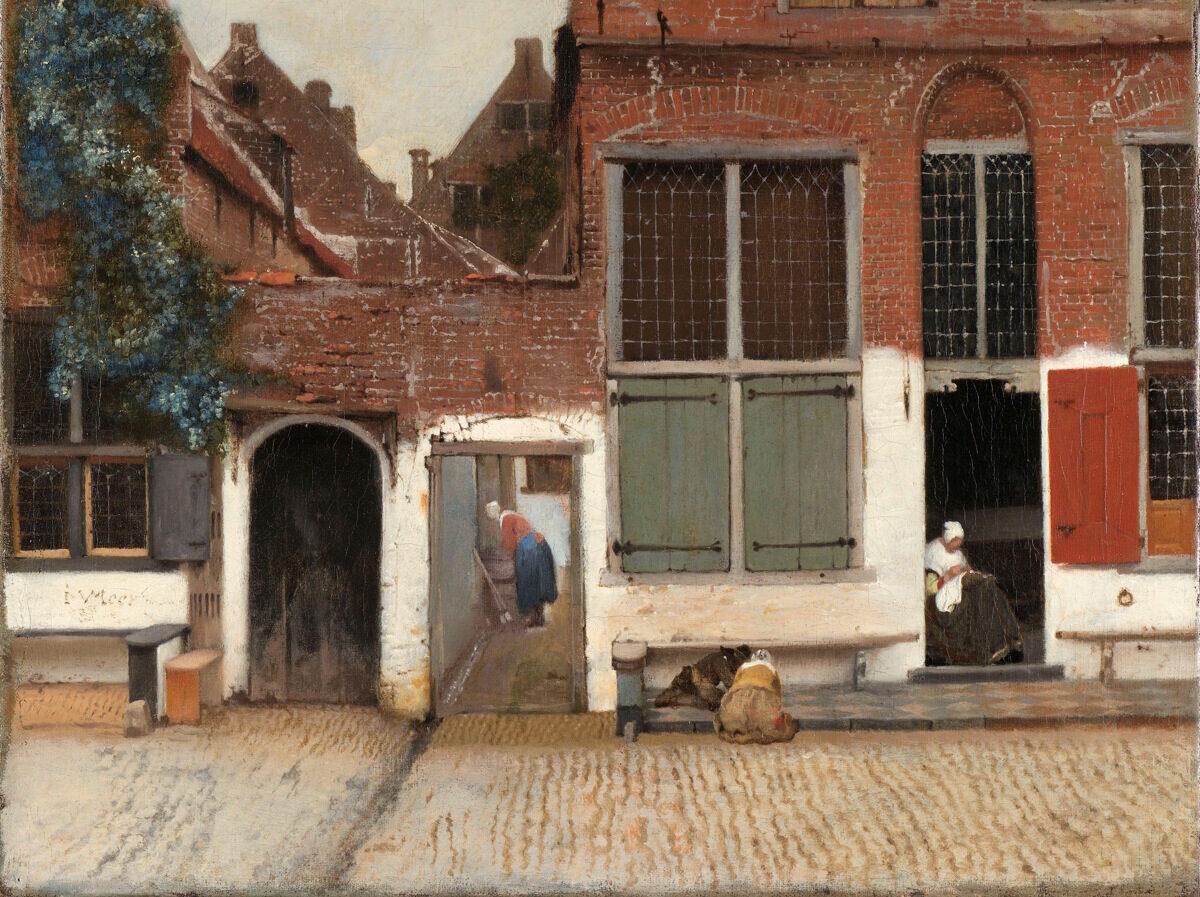
The Rijksmuseum holds four paintings: The Milkmaid (c. 1657–1658), Woman Reading a Letter, The Little Street (the only other surviving cityscape), and Woman in Blue Reading a Letter. The Milkmaid is arguably the finest example of Vermeer's domestic realism, the kind of painting that rewards close looking over a long time. The Vermeer gallery is in the Gallery of Honour on the second floor (floor 2) of the main building, the same hall where Rembrandt's Night Watch hangs.
Open daily 9:00–17:00. Book at least a week in advance, particularly on weekends and during school holidays. Early morning slots (9:00–10:00) tend to be less crowded.
Book a guided tour of the Rijksmuseum
Frick Collection, New York
3 Vermeers – currently at Frick Madison (945 Madison Ave)
The Frick holds Girl Interrupted at Her Music, Mistress and Maid, and Officer and Laughing Girl. While the original Frick mansion on 70th Street is undergoing renovation, the collection is displayed at Frick Madison (the former Breuer building, 945 Madison Ave at 75th Street). Check current display status before visiting, as the return to the mansion will eventually change room arrangements. The Metropolitan Museum of Art, a few blocks south on Fifth Avenue, also holds Vermeers: A Maid Asleep, Study of a Young Woman, Allegory of the Catholic Faith, and Young Woman with a Water Pitcher.
Book Frick Collection tickets –
Book a guided tour of the Metropolitan Museum
Metropolitan Museum of Art, New York
4 – 5 Vermeers in the European Paintings galleries (second floor)
The Met holds Young Woman with a Water Pitcher (c. 1662), A Maid Asleep (c. 1656–1657), Study of a Young Woman (c. 1665–1667), Allegory of the Catholic Faith (c. 1670–1672), and the recently acquired Portrait of a Young Woman with a Flute (attribution debated). These are displayed in the Dutch Golden Age rooms on the second floor. Combined with the Frick, a single day on the Upper East Side gives you up to eight Vermeers.
Open Sunday through Tuesday and Thursday 10:00–17:00, Friday and Saturday 10:00–21:00. Closed Wednesdays. Suggested admission for non-New York residents: $30.
Book a guided tour of the Metropolitan Museum
National Gallery of Art, Washington D.C.
3 confirmed Vermeers + 1 attributed to his studio – free admission
The NGA holds three works firmly attributed to Vermeer: Girl with the Red Hat (c. 1666–1667), Woman Holding a Balance (c. 1664), and A Lady Writing (c. 1665). A fourth painting, Girl with a Flute, was long attributed to Vermeer but is now considered by the museum's own curators to be the work of an unknown person in his studio circle, probably an apprentice. All four remain on display and are worth seeing regardless of attribution.
The Vermeer and Dutch Golden Age paintings are in the West Building, ground floor, galleries 50A–51. Open daily 10:00–17:00. No admission charge, no advance booking required for regular visits.
Book a guided tour of the National Gallery of Art
National Gallery, London
2 Vermeers in Room 16 – free admission
A Young Woman Standing at a Virginal (c. 1670–1672) and A Young Woman Seated at a Virginal (c. 1670–1672) are both here, two paintings that may be pendant works and are rarely seen together outside London. Admission is free, no booking needed for general entry. Room 16 also holds major Dutch Golden Age paintings by de Hooch and Metsu, making it a strong room to spend time in. The gallery is on the north side of Trafalgar Square.
Book a guided tour of the National Gallery London
Louvre, Paris
2 Vermeers: The Lacemaker and The Astronomer – Richelieu wing
The Lacemaker (c. 1669–1671) is one of Vermeer's smallest paintings and one of his most concentrated: 24 by 21 cm, nothing wasted. The Astronomer (1668) is rare as one of his dated works, paired thematically with The Geographer in Frankfurt. Both are in the Richelieu wing, third floor, Dutch paintings section (rooms 837–838).
Open daily except Tuesday, 9:00–18:00 (Wednesday and Friday until 21:45). Book timed entry at least 3–5 days ahead; queues without a ticket can exceed 90 minutes.
Book a guided tour of the Louvre
Gemäldegalerie, Berlin
2 Vermeers – Young Woman with a Pearl Necklace and The Glass of Wine
Young Woman with a Pearl Necklace (c. 1664) and The Glass of Wine (c. 1661–1662) are displayed in the Dutch Golden Age rooms of the Gemäldegalerie at the Kulturforum. The museum holds one of Europe's strongest Dutch collections, with works by Rembrandt, Hals, and de Hooch nearby. Open Tuesday through Friday 10:00–18:00, Saturday and Sunday 11:00–18:00. Closed Mondays.
Book tickets for the Gemäldegalerie Berlin
Kunsthistorisches Museum, Vienna
1 Vermeer: The Art of Painting – one of his largest and most ambitious works
The Art of Painting (c. 1666–1668) is Vermeer's most self-consciously complex composition: a painter at work in his studio, a map on the back wall, an elaborate curtain pulled aside. At roughly 120 × 100 cm, it is also among his largest canvases. It hangs in the Picture Gallery on the first floor (Saal X), alongside works by Dutch and Flemish contemporaries. The KHM is on the Ringstrasse, directly opposite the Naturhistorisches Museum.
Open daily except Monday, 10:00–18:00 (Thursday until 21:00). Booking online saves queuing time.
Book tickets for the Kunsthistorisches Museum Vienna
Gemäldegalerie Alte Meister, Dresden
1 Vermeer: Girl Reading a Letter at an Open Window (recently restored)
Girl Reading a Letter at an Open Window (c. 1657–1659) underwent a major restoration completed in 2021 that revealed a large painting of Cupid on the back wall, hidden under an overpaint added after Vermeer's death. The restored version significantly changes the reading of the painting. It is displayed in the Zwinger palace complex. Open daily except Monday, 10:00–18:00.
Visit the Gemäldegalerie Alte Meister website