ⓘ Opening hours and admission prices listed on this page are indicative and subject to change. Always verify current information on the official website of each venue before your visit.
Basilica di San Francesco, Arezzo
Legend of the True Cross (c. 1452 – 1466) · Booking required · Max 25 visitors per 30-min slot
The choir of this Franciscan church holds Piero's monumental fresco cycle telling the story of the True Cross in twelve scenes across three registers. Key episodes include the Dream of Constantine (the first nocturne in Italian painting), the Battle of Heraclius and Chosroes, the Queen of Sheba Meeting Solomon, and the Discovery and Proof of the True Cross. The cycle was restored between 1985 and 2000. Visits are timed and limited; book at least a week ahead in high season (April – October). The basilica is a 5-minute walk uphill from Arezzo train station.
Basilica di San Francesco official site
Museo Civico, Sansepolcro
Resurrection (c. 1460), San Giuliano polyptych, San Ludovico fresco · Open daily except some Mondays
Piero's birthplace holds the Resurrection in the main hall on the ground floor, a fresco that Aldous Huxley called "the greatest painting in the world." The risen Christ stares directly at the viewer while four soldiers sleep below. In the same museum you'll find the San Giuliano polyptych (fragmentary) and the detached San Ludovico fresco. Sansepolcro is about 40 minutes by car east of Arezzo. Allow 1 – 2 hours for the museum and the small historic center.
Museo Civico Sansepolcro official site
Museo Madonna del Parto, Monterchi
Madonna del Parto (c. 1455 – 1465) · Small single-work museum
This detached fresco, originally in the chapel of the cemetery of Monterchi, shows the pregnant Virgin flanked by two angels who pull open a curtain-like tent. The work is now displayed in a dedicated museum in the center of Monterchi. The village sits on a hill between Arezzo and Sansepolcro, reachable only by car. A combined visit with Sansepolcro is practical: Monterchi is roughly 15 minutes south of Sansepolcro. Opening hours vary seasonally; check ahead in winter.
Museo Madonna del Parto official site
Galleria Nazionale delle Marche, Urbino
Flagellation (c. 1455 – 1460), Madonna di Senigallia (c. 1474) · Palazzo Ducale
Inside the Palazzo Ducale of Urbino, the Galleria Nazionale delle Marche holds two of Piero's most studied works. The Flagellation of Christ, a small panel (58.4 × 81.5 cm), presents a mysterious architectural perspective splitting the scene between the biblical flagellation and three unidentified foreground figures. The Madonna di Senigallia shows the Virgin with Child and two angels in a domestic interior suffused with cool, silvery light from a window at left. Both works are displayed on the piano nobile. The palace itself, designed by Luciano Laurana, is one of the finest examples of Renaissance architecture.
Book Galleria Nazionale delle Marche guided tour ·
Official site
Galleria degli Uffizi, Florence
Diptych of the Duke and Duchess of Urbino (c. 1473 – 1475) · Room 8
The double portrait of Federico da Montefeltro and Battista Sforza is displayed in Room 8 on the second floor. The panels show the couple in strict profile against an aerial landscape of the Montefeltro hills. The reverse sides (visible in the same room) depict their triumphal processions. The painting is small (each panel 47 × 33 cm) and often crowded, so visit early. The Uffizi also holds Piero's unfinished Battle of San Romano predella fragment attributed to his circle.
Book Uffizi tickets ·
Uffizi guided tour
Pinacoteca di Brera, Milan
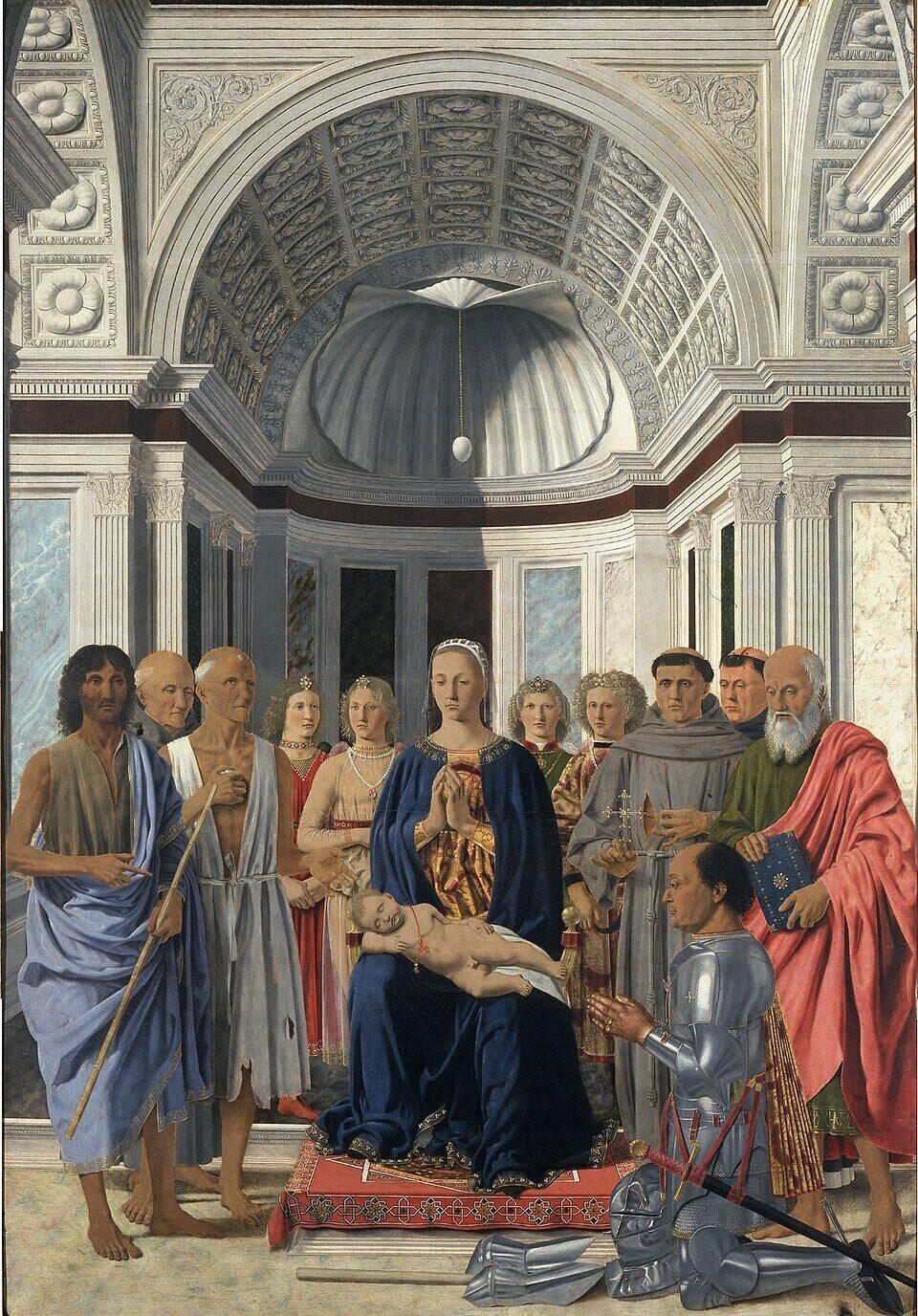
Montefeltro Altarpiece (Brera Madonna, c. 1472 – 1474) · Room VI
The Pala di Brera (also called the Montefeltro Altarpiece) is one of Piero's largest and most complex panel paintings. The Virgin with sleeping Child is enthroned beneath an apse shell from which hangs an ostrich egg, surrounded by saints and angels, with the kneeling Federico da Montefeltro in full armor at lower right. The architectural setting demonstrates Piero's command of perspective with mathematical precision. Located in Room VI of the Pinacoteca di Brera.
Book Pinacoteca di Brera guided tour
Tempio Malatestiano, Rimini
Sigismondo Pandolfo Malatesta Before St. Sigismund (1451) · Right aisle chapel
This fresco shows Sigismondo Malatesta kneeling before his patron saint, flanked by two greyhounds, in a rigorously constructed architectural frame. It is Piero's earliest dated work. The Tempio Malatestiano (designed by Leon Battista Alberti) is Rimini's cathedral and can be visited freely. Rimini is about 1.5 hours by car from Arezzo via the E45, making it a feasible addition to a Piero itinerary that already includes Sansepolcro and Urbino.
National Gallery, London
Baptism of Christ (c. 1448 – 1450), Nativity (c. 1470 – 1475), St. Michael · Room 66
The National Gallery holds three Piero panels. The Baptism of Christ is perhaps the most reproduced: Christ stands at center beneath a tree while the dove of the Holy Spirit descends along the vertical axis, with three angels at left. The Nativity (unfinished) shows singing angels with lutes before a rustic shed. Both are displayed in Room 66 of the Sainsbury Wing. Admission to the National Gallery is free; no booking needed for the permanent collection.
Book National Gallery London guided tour
Museo di Capodimonte, Naples
Possible attribution: a small St. Jerome panel · Second floor
The Capodimonte collection includes a small St. Jerome panel attributed to Piero or his workshop. While not among his major works, it is worth noting for travelers already visiting Naples. The museum sits in the Capodimonte park, north of the historic center.
Book Capodimonte tickets
Museu Nacional de Arte Antiga, Lisbon
St. Augustine (c. 1454 – 1469) from the Sant'Agostino altarpiece
One of four surviving panels from a dismembered polyptych originally in the church of Sant'Agostino in Sansepolcro. This panel shows St. Augustine in full episcopal vestments encrusted with miniature narrative scenes. Other panels from the same altarpiece are in the Frick Collection (New York), the National Gallery (London), and the Poldi Pezzoli Museum (Milan).
Museu Nacional de Arte Antiga official site
Frick Collection, New York
St. John the Evangelist (c. 1454 – 1469) from the Sant'Agostino altarpiece
The Frick holds the St. John the Evangelist panel from the same dismembered Sansepolcro polyptych. Displayed in the intimate galleries of the former Frick mansion on the Upper East Side. Combined with the Metropolitan Museum (a short walk south), a Piero-focused visit in New York is efficient.
Book Frick Collection visit