ⓘ Opening hours and admission prices listed on this page are indicative and subject to change. Always verify current information on the official website of each venue before your visit.
Musée Picasso Paris
5 Rue de Thorigny, Marais (3rd arr.) – Over 5,000 works – Timed entry recommended
Housed in the 17th-century Hôtel Salé, the collection spans Picasso's entire career across five floors. Ground floor: early works including Self-Portrait (1901) and Blue Period paintings. First floor: Cubist works such as Still Life with Chair Caning (1912) and Man with a Guitar (1911). Second floor: neoclassical and Surrealist periods, including The Kiss (1925). Third floor: sculptures, ceramics, and graphic works. The museum also displays Picasso's personal collection of works by Cézanne, Matisse, Degas, and Rousseau. Open Tuesday to Sunday, 10:30 to 18:00 (until 21:00 on the third Friday of each month). Book 3–5 days ahead in peak season.
Book Musée Picasso Paris tickets
Museu Picasso Barcelona
Carrer Montcada 15–23 (El Born) – 4,251 works – Guided tours available
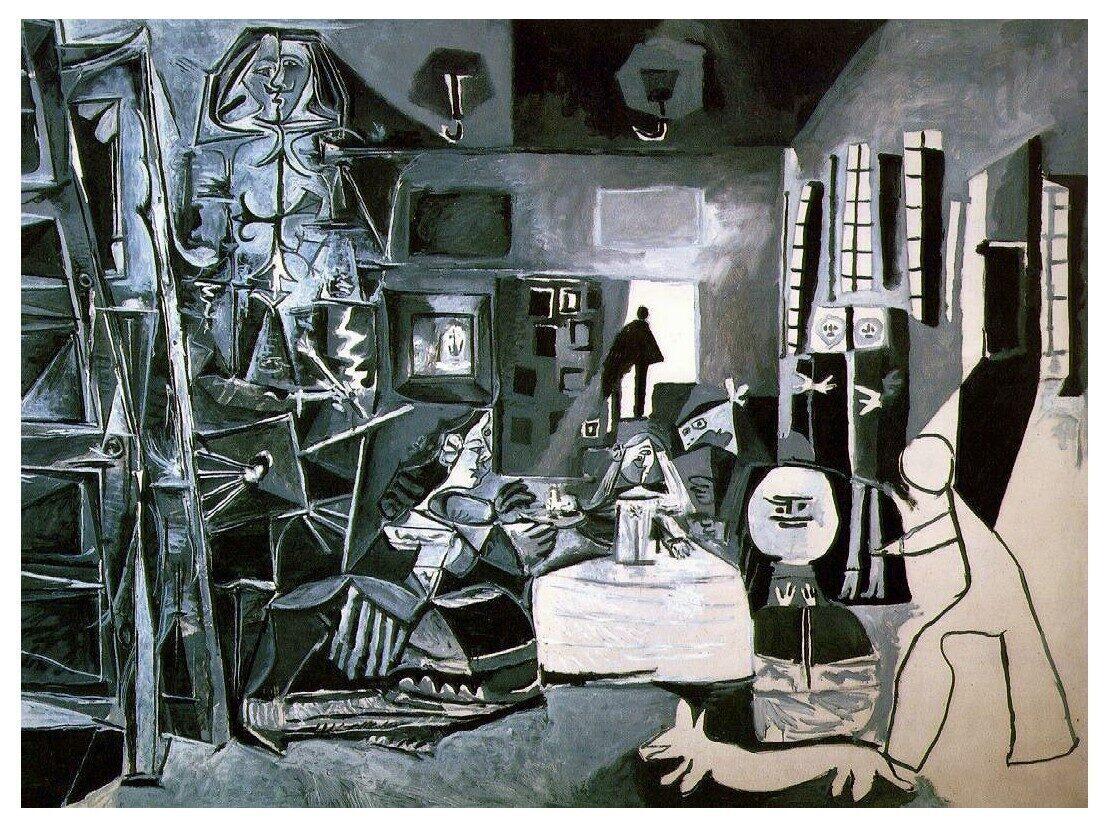
Five connected medieval palaces house the most complete collection of Picasso's formative years. Highlights: Science and Charity (1897, Room 3), the complete Las Meninas series (58 paintings after Velázquez, 1957, dedicated room on the second floor), early Barcelona sketchbooks, Blue Period works including Rooftops of Barcelona (1903), and a large ceramics collection on the top floor. Open Tuesday to Sunday, 10:00 to 19:00 (Thursday until 21:30). Free entry on the first Sunday of each month, but queues can exceed 90 minutes. Book guided tours at least a week ahead.
Book Museu Picasso Barcelona guided tour
MoMA, New York
11 West 53rd Street, Manhattan – Major Cubist and modern holdings
MoMA's fifth floor holds the most important Picasso works in the United States. Gallery 2: Les Demoiselles d'Avignon (1907), the painting that broke with Western pictorial tradition. Same floor: Three Musicians (1921), Girl before a Mirror (1932), Studio with Plaster Head (1925). The fourth floor often displays prints and drawings from MoMA's extensive Picasso graphic holdings (over 100 prints). Open daily 10:30 to 17:30, Saturday until 19:00.
Book MoMA tickets
Museo Reina Sofía, Madrid (Guernica)
Calle de Santa Isabel 52 – Building Sabatini, 2nd floor, Room 206.06
Guernica (1937) occupies its own room with Dora Maar's photographic documentation and over 40 preparatory sketches displayed in adjacent rooms 206.04 and 206.05. The painting (349 × 776 cm) depicts the bombing of the Basque town during the Spanish Civil War. Photography is not allowed in the Guernica room. The Reina Sofía also holds Woman in Blue (1901) and several Cubist works. Open Monday and Wednesday to Saturday, 10:00 to 21:00; Sunday 10:00 to 14:30; closed Tuesday. Free entry Monday and Wednesday to Saturday 19:00–21:00, Sunday 12:30–14:30.
Musée Picasso Antibes
Château Grimaldi, Place Mariejol – Works from autumn 1946 studio residency
In 1946, the municipality offered Picasso the Château Grimaldi as a temporary studio. He left behind 23 paintings and 44 drawings, now the core of this collection. Key works: La Joie de vivre (1946), Still Life with Watermelon (1946), and Ulysses and the Sirens (1947). The terrace displays sculptures overlooking the Mediterranean. Open Tuesday to Sunday, 10:00 to 13:00 and 14:00 to 18:00 (extended hours in summer). No advance booking needed; rarely crowded.
Musée Picasso Antibes (official site)
Kunstmuseum Basel
St. Alban-Graben 16 – Important Cubist and late works
Basel's collection includes The Two Brothers (1906, Rose Period), Bread and Fruit Dish on a Table (1909), and several Cubist still lifes from 1911–1914. The museum also holds Picasso's Seated Harlequin (1923) and late paintings. These are displayed on the second floor alongside works by Braque and Gris, which makes Basel particularly effective for understanding Cubism in context. Open Tuesday to Sunday 10:00 to 18:00, Wednesday until 20:00.
Kunstmuseum Basel (official site)
Art Institute of Chicago
111 South Michigan Avenue – Gallery 391 (Modern Wing)
The Modern Wing holds The Old Guitarist (1903–1904), one of the most recognized Blue Period paintings. Also on display: Mother and Child (1921), Daniel-Henry Kahnweiler (1910, a key Analytic Cubist portrait), and The Red Armchair (1931). Gallery 391 is on the third floor. The museum is open daily, 11:00 to 18:00 (Thursday until 20:00).
Book Art Institute of Chicago tickets
Musée de l'Orangerie, Paris
Jardin des Tuileries (1st arr.) – Lower level, Jean Walter and Paul Guillaume collection
The lower galleries hold important Picasso works from the Walter-Guillaume bequest: The Adolescents (1906), Large Bather (1921), Female Bathers (1923), and several still lifes. Displayed alongside works by Renoir, Cézanne, Modigliani, and Matisse. The museum is small enough to visit in 90 minutes, combining Monet's Nymphéas (upper level) with the Picasso holdings below.
Book Musée de l'Orangerie tickets
Centre Pompidou, Paris
Place Georges-Pompidou (4th arr.) – Level 5, modern collections
The Pompidou's permanent collection includes significant Cubist paintings and works from the 1930s–1940s. Among the holdings: Portrait of a Young Girl (1914), Still Life with Skull, Leeks and Pitcher (1945), and a number of collages. The Cubist rooms (Level 5) place Picasso alongside Braque, Léger, and Gris. Note: the Pompidou is scheduled for renovation (check current access status before visiting). A 10-minute walk from the Musée Picasso Paris.
Centre Pompidou (official site)
Museo del Prado, Madrid
Paseo del Prado – Context rather than collection
The Prado does not hold Picasso's own works but is essential for understanding him. Picasso's Las Meninas series (Barcelona) responds directly to Velázquez's original in Room 12. His variations on El Greco, Zurbarán, and Goya all depend on sustained engagement with the Prado. A 15-minute walk from the Reina Sofía. Combine both in a single day: Prado in the morning, Guernica in the afternoon.
Book Museo del Prado tickets