Artist page

Where to See Masaccio

Tommaso di Ser Giovanni di Simone, known as Masaccio (1401–1428), worked for barely six years before dying at 26 in Rome. In that time he produced the frescoes that introduced consistent perspective, volumetric modelling, and unified light into European painting. Almost all his surviving work is in Florence, concentrated in two sites: the Brancacci Chapel in Santa Maria del Carmine and the nave of Santa Maria Novella.

This page maps every known location where Masaccio's works can be seen today, from the Brancacci Chapel frescoes to scattered altarpiece panels in London, Berlin, Naples, and Los Angeles. Use the interactive map and the museum blocks below to plan a visit around the specific sites.

Detail from Masaccio's Tribute Money fresco in the Brancacci Chapel, Florence

Explore Masaccio on the map

Tap to activate map

Where to see Masaccio: key sites

ⓘ Opening hours and admission prices listed on this page are indicative and subject to change. Always verify current information on the official website of each venue before your visit.

Brancacci Chapel, Santa Maria del Carmine, Florence

Main frescoes: The Tribute Money, Expulsion from the Garden of Eden, St. Peter Baptizing the Neophytes, The Distribution of Alms and Death of Ananias (c. 1424–1427). Book at least 3–5 days in advance.

The Brancacci Chapel is the single most important Masaccio site. The cycle, begun with Masolino and later completed by Filippino Lippi, covers the upper and lower registers of the chapel walls. Masaccio's scenes occupy the left wall and part of the right: The Tribute Money fills the entire upper-left lunette, while the Expulsion is on the upper-left entrance pilaster. Visits are limited to 30 people per 20-minute slot. The chapel is inside the church of Santa Maria del Carmine, on the Oltrarno side of Florence (Piazza del Carmine). Open Monday and Wednesday through Saturday 10:00–17:00, Sunday 13:00–17:00. Closed Tuesday.

Book Brancacci Chapel guided tour

Santa Maria Novella, Florence

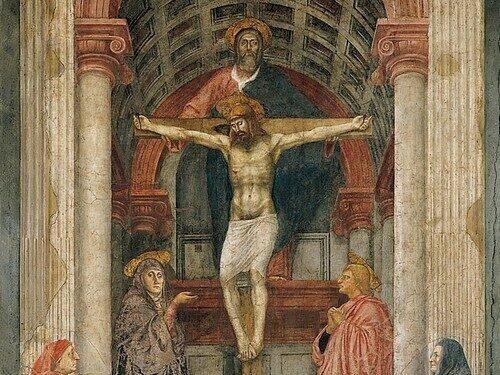
Holy Trinity (c. 1427), left nave wall. One of the earliest surviving works using Brunelleschi's linear perspective.

The Trinity fresco is on the third bay of the left aisle, at eye level. It depicts Christ crucified within an architectural niche painted with precise one-point perspective, flanked by the Virgin and St. John, with the two donors kneeling below. The skeleton at the base carries the inscription "I was once what you are, and what I am you shall become." The church also contains major works by Ghirlandaio, Filippino Lippi, and Giotto's Crucifix. Entry ticket costs about €7.50.

Book Santa Maria Novella tickets

Galleria degli Uffizi, Florence

Madonna and Child with Saint Anne (c. 1424, with Masolino), Room 7, second floor.

This panel is a collaboration: Masaccio painted the Madonna, Child, and the angel at lower right, while Masolino executed Saint Anne and the remaining angels. The difference in solidity and spatial construction between the two hands is immediately visible. Room 7 also displays works by other early Renaissance Florentine painters, including Paolo Uccello and Fra Angelico. Book Uffizi tickets at least a week ahead in high season.

Book Uffizi ticketsUffizi guided tour

Masaccio panels outside Florence (the dispersed Pisa Altarpiece)

Masaccio's Pisa Altarpiece (1426), originally in the church of Santa Maria del Carmine in Pisa, was dismembered in the 18th century. Its panels are now scattered across several museums:

National Gallery, London

Madonna and Child (central panel from the Pisa Altarpiece, 1426), Room 60. Free admission.

The central panel shows the Virgin enthroned with the Christ Child eating grapes. The throne recedes in perspective, and the figures carry real weight. The National Gallery also holds fragments including two saints from the same altarpiece. Open daily 10:00–18:00, Fridays until 21:00.

Book National Gallery London guided tour

Gemäldegalerie, Berlin

Panels from the Pisa Altarpiece predella and side saints, including Adoration of the Magi and four small saint panels.

The Gemäldegalerie holds several fragments from the Pisa Altarpiece's predella, displayed in the early Italian rooms on the ground floor. The museum is at the Kulturforum, near Potsdamer Platz. Open Tuesday through Friday 10:00–18:00, weekends 11:00–18:00. Closed Monday.

Book Gemäldegalerie Berlin tickets

Museo di Capodimonte, Naples

Crucifixion (1426), from the top register of the Pisa Altarpiece. Second floor, Farnese Collection.

This small gold-ground panel (83 × 63 cm) is among Masaccio's most intense works: the foreshortened figure of Mary Magdalene, seen from behind with arms flung upward, is a landmark in rendering emotion through bodily gesture. Capodimonte is in a hilltop park above Naples, reachable by bus (line 178 from Museo Nazionale) or taxi.

Book Capodimonte tickets

Getty Museum, Los Angeles

Saint Andrew (1426), a panel from the Pisa Altarpiece. Getty Center, North Pavilion.

A single standing saint figure, modelled with strong light from the left. The Getty Center is in Brentwood, Los Angeles. Admission is free, but parking reservations are required. Open Tuesday through Sunday 10:00–17:30.

Visit Getty Museum website
Planning a Masaccio visit in Florence

Suggested route

A half-day Masaccio walk in Florence

Start at the Brancacci Chapel (book the 10:00 slot). Cross the Arno via Ponte alla Carraia, walk 15 minutes to Santa Maria Novella for the Trinity. Continue east along Via dei Calzaiuoli (20 minutes) to the Uffizi for the Madonna and Child with Saint Anne. Total walking time: about 45 minutes, plus visits.

Practical note

Booking and timing

The Brancacci Chapel is the bottleneck: limited to 30 visitors per 20-minute slot, it requires advance booking online (book here). The Uffizi should also be pre-booked (at least a week ahead in summer). Santa Maria Novella rarely sells out but queues form at midday. Visit early or after 15:00.

Context

Masaccio alongside his contemporaries

While in Florence, compare Masaccio's spatial logic with Masolino's panels in the same Brancacci Chapel, Fra Angelico's work at San Marco (10 minutes from Santa Maria Novella), and Brunelleschi's architecture at Santo Spirito and San Lorenzo, which provided the structural principles Masaccio applied to paint.

Best city pages for Masaccio

Florence

Three sites within walking distance hold all of Masaccio's Florentine work: Brancacci Chapel, Santa Maria Novella, and the Uffizi. The Florence city page covers all three with practical details, booking links, and related artists.

Open the full ArtAtlas map

See all surviving Masaccio locations at a glance: Florence, London, Berlin, Naples, Los Angeles. Filter by artist and zoom to plan your route.

Continue with Giotto

Giotto (active c. 1267–1337) laid the foundations that Masaccio built on a century later. Compare the Scrovegni Chapel in Padua with the Brancacci Chapel to see how pictorial space evolved from narrative fresco to constructed perspective.

FAQ

Do I need to book the Brancacci Chapel in advance?

Yes, advance booking is strongly recommended. The chapel admits only 30 visitors at a time for 20-minute slots. During peak season (March through October), slots sell out days ahead. Book at least 3 to 5 days in advance online. Book Brancacci Chapel tickets.

Where is Masaccio's Trinity fresco?

The Holy Trinity (c. 1427) is on the left wall of the nave in Santa Maria Novella, Florence, about halfway down, at eye level. Entry to the church requires a ticket (around €7.50).

Which Masaccio works are in the Uffizi?

The Uffizi holds the Madonna and Child with Saint Anne (c. 1424, with Masolino) in Room 7 on the second floor. The San Giovenale Triptych (1422), his earliest known work, is in the Museo Masaccio at Cascia di Reggello, about 40 km from Florence.

Can I see the Brancacci Chapel and Santa Maria Novella in one day?

Yes. The two sites are about 15 minutes apart on foot across the Arno. Book the Brancacci Chapel for the morning, then walk to Santa Maria Novella. You can add the Uffizi in the afternoon (a further 20-minute walk east).

Are there Masaccio works outside Florence?

Yes. The 1426 Pisa Altarpiece was dismembered: the central Madonna and Child is at the National Gallery in London, predella panels at the Gemäldegalerie in Berlin, the Crucifixion at Capodimonte in Naples, and Saint Andrew at the Getty Museum in Los Angeles.

Read Masaccio on TheIntroverTraveler

Venice canal

The Frescoes of the Brancacci Chapel

Masaccio, Masolino, and Filippino Lippi's fresco cycle in Santa Maria del Carmine: how to read the scenes, why the Expulsion and Tribute Money changed painting, and what to look for during your 20-minute slot.

The Uffizi Gallery in Florence

A structured guide to the Uffizi, including the early Renaissance rooms where Masaccio's Madonna and Child with Saint Anne (with Masolino) is displayed alongside Botticelli and Filippo Lippi.

The Art of Fresco Painting

Techniques, historical evolution, and the material conditions of Italian monumental painting — essential context for understanding what Masaccio was working with and against in the Brancacci Chapel.

Masaccio, mapped from chapel to museum.

In barely six years of work, Masaccio established the rules that shaped Italian painting for the next century: consistent one-point perspective, light falling from a single source, figures with mass and weight. The Brancacci Chapel alone repays a trip to Florence. The dispersed panels of the Pisa Altarpiece give you reasons to return to London, Berlin, and Naples with fresh eyes. Start on the map and follow the works.

.js">