ⓘ Opening hours and admission prices listed on this page are indicative and subject to change. Always verify current information on the official website of each venue before your visit.
Galleria degli Uffizi, Florence
Room 35, second floor – book at least 1 week ahead in high season
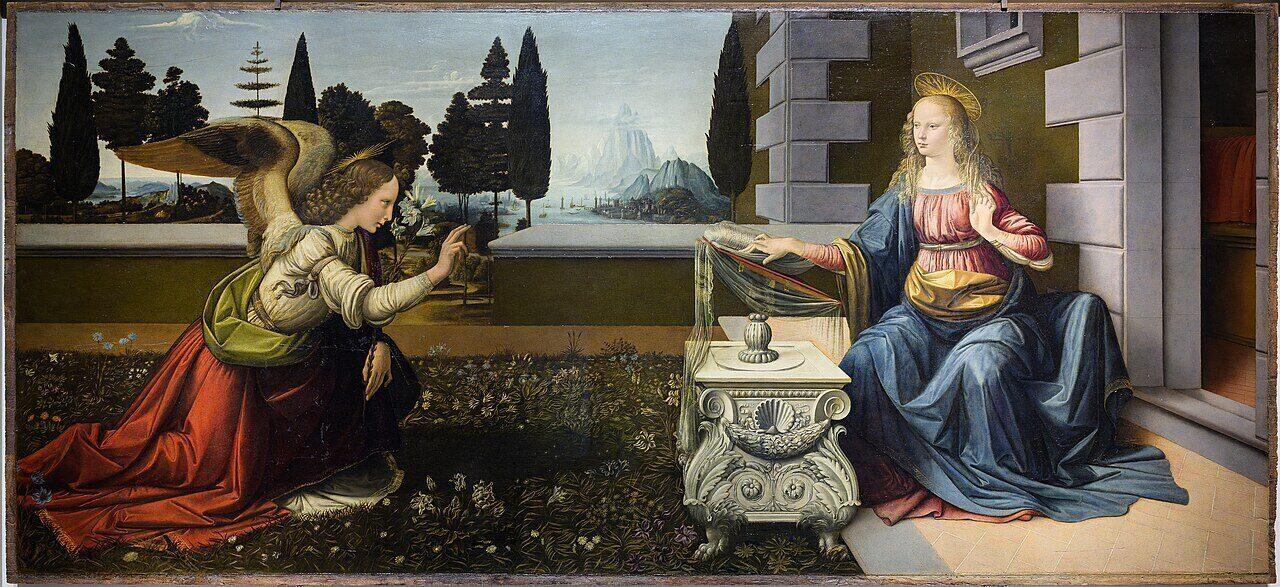
Two essential early works hang here. The Annunciation (c. 1472 – 1475) is one of Leonardo's first independent paintings, notable for its careful botanical rendering and atmospheric perspective in the background landscape. The Adoration of the Magi (1481, unfinished) reveals his revolutionary compositional method: a swirling crowd of figures radiating from the Madonna and Child, left as a brown-toned underpainting when Leonardo departed for Milan. The unfinished state makes visible his layering process, from geometric perspective lines to expressive gestural figures. The same room includes the Baptism of Christ by Verrocchio, where Leonardo painted the kneeling angel on the far left (his earliest identified contribution to a painting).
Book Uffizi tickets –
Uffizi guided tour
Cenacolo Vinciano (Santa Maria delle Grazie), Milan
Refectory, ground floor – book 2 – 3 months ahead; 15-minute timed visits only
The Last Supper (1495 – 1498) occupies the entire end wall of the refectory. Leonardo painted it using an experimental oil-and-tempera technique on dry plaster (not true fresco), which began deteriorating almost immediately. The current state is the result of Pinin Brambilla Barcilon's 21-year restoration (completed 1999), which removed centuries of overpainting to reveal Leonardo's original colour and spatial illusion. Only 25 visitors are admitted every 15 minutes. The entrance is on Piazza Santa Maria delle Grazie; arrive 15 minutes before your slot.
Book Last Supper guided tour
Pinacoteca Ambrosiana, Milan
Room 2 – no advance booking usually required
The Portrait of a Musician (c. 1485) is the only Leonardo male portrait to survive on panel. It shows a young man holding a sheet of music, with the face highly finished and the clothing left in a rougher state. The Ambrosiana also holds pages from the Codex Atlanticus (the largest collection of Leonardo's drawings and writings), displayed in rotating exhibitions in the Federiciana rooms downstairs.
Book Pinacoteca Ambrosiana tickets
Castello Sforzesco, Milan
Sala delle Asse, ground floor – check opening status before visiting
The Sala delle Asse is a vaulted room decorated by Leonardo (c. 1498) with an illusionistic canopy of interlaced mulberry branches and roots painted across walls and ceiling, commissioned by Ludovico Sforza. The room has undergone extensive restoration cycles. When open, it offers a rare example of Leonardo's decorative and architectural painting.
Book Castello Sforzesco tickets
Musée du Louvre, Paris
Denon Wing, first floor (Rooms 710 – 711) – book online, arrive early morning or after 15:00
The Louvre holds five Leonardo paintings, the largest concentration anywhere. The Mona Lisa (c. 1503 – 1519) hangs behind glass in the Salle des États (Room 711). In adjacent rooms of the Grande Galerie (Room 710): the Virgin of the Rocks (Louvre version, c. 1483 – 1486), the Belle Ferronnière (c. 1490 – 1497), the Virgin and Child with St. Anne (c. 1503 – 1519), and St. John the Baptist (c. 1513 – 1516). Viewing all five requires moving between Room 711 and the Italian painting galleries in the Grande Galerie. The Virgin and Child with St. Anne is particularly important for its pyramidal composition and sfumato modelling; the St. John the Baptist represents Leonardo's late style at its most distilled, with figure emerging from near-total darkness.
Book Louvre guided tour
Vatican Museums, Rome
Pinacoteca Vaticana, Room XII – included in general Vatican ticket
The unfinished St. Jerome in the Wilderness (c. 1480) is a monochrome underpainting on walnut panel showing the penitent saint kneeling before a crucifix, with a lion at his feet. The anatomy of Jerome's neck and shoulder is remarkably precise, reflecting Leonardo's dissection studies. The panel was cut into two pieces at some point and reassembled; the join is still visible. Room XII also displays Raphael's Transfiguration and Caravaggio's Deposition, making it one of the most important single rooms in Rome.
Book Vatican Museums tickets –
Vatican guided tour with Sistine Chapel
Palazzo Vecchio, Florence
Salone dei Cinquecento – accessible with Palazzo Vecchio ticket
The vast Salone dei Cinquecento is where Leonardo began (and abandoned) the Battle of Anghiari (1505), a monumental wall painting that was never completed and is now lost beneath Vasari's later frescoes. Diagnostic investigations have searched for traces beneath the existing surface. While no Leonardo painting is visible today, the room itself is the site of the most famous lost work in Renaissance art, and understanding it adds depth to any Leonardo itinerary.
Book Palazzo Vecchio tickets
National Gallery, London
Room 66 – free admission, no booking required
The London Virgin of the Rocks (c. 1495 – 1508), the later of the two versions, hangs in Room 66. It differs from the Louvre version in lighting, finish, and the addition of haloes and the Baptist's cross-staff (likely by assistants). The Burlington House Cartoon (c. 1499 – 1500), a full-scale charcoal and chalk drawing of the Virgin and Child with St. Anne and St. John the Baptist, is displayed nearby. This is one of the finest surviving Leonardo drawings of monumental scale.
National Gallery London guided tour
Hermitage Museum, Saint Petersburg
Leonardo Hall, second floor of the Large Hermitage
The Benois Madonna (c. 1478 – 1480) and the Madonna Litta (c. 1490, with significant workshop involvement, possibly Giovanni Antonio Boltraffio) are displayed together. The Benois Madonna is notable as one of Leonardo's earliest independent works, showing a young Virgin offering a flower to the Christ Child with a naturalism that breaks from the stiff Florentine conventions of the 1470s.
Visit the Hermitage Museum website
Other notable locations
Smaller collections with single Leonardo works
Alte Pinakothek, Munich: Madonna of the Carnation (c. 1478 – 1480). National Gallery of Art, Washington: Ginevra de' Benci (c. 1474 – 1478), the only Leonardo painting in the Americas. Czartoryski Museum, Kraków: Lady with an Ermine (c. 1489 – 1491), a portrait of Cecilia Gallerani painted during Leonardo's first Milanese period.
National Gallery of Art Washington guided tour