Artist page

Where to See Hans Holbein the Younger

Holbein's surviving works are concentrated in a handful of cities: London holds the most famous Tudor portraits and The Ambassadors at the National Gallery; Basel preserves the largest single collection, including The Body of the Dead Christ in the Tomb at the Kunstmuseum; and New York offers key portraits at the Frick Collection and the Metropolitan Museum. Smaller but important groups appear in Dresden, Vienna, The Hague, and Berlin.

This page maps every major Holbein location, links to the relevant museum pages, and provides practical booking information for each site. Use it to plan a focused itinerary around his portraiture, religious panels, and drawing collections.

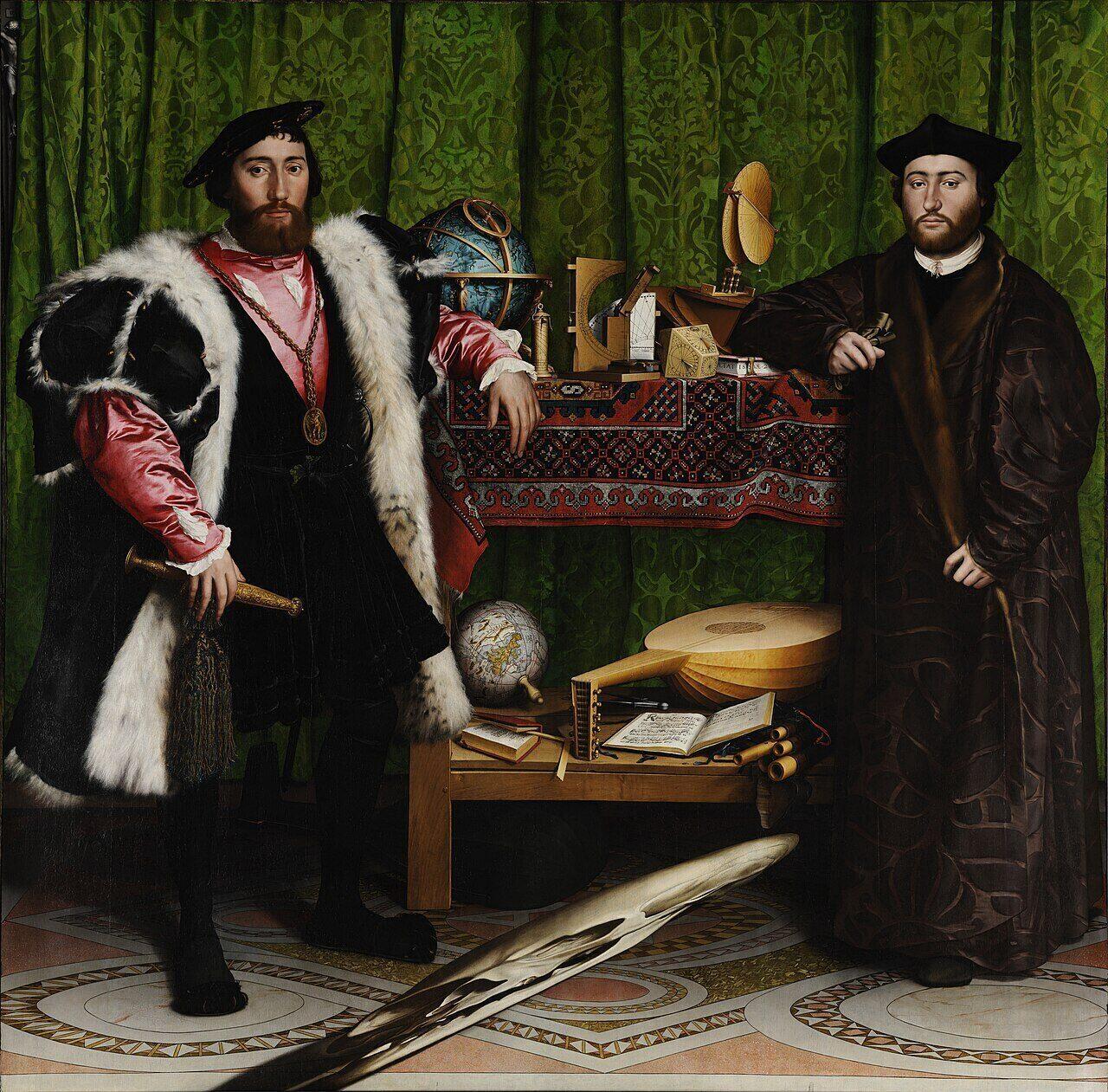
The Ambassadors by Hans Holbein the Younger, 1533, National Gallery London

Explore Holbein on the map

Tap to activate map

Key museums for Holbein

ⓘ Opening hours and admission prices listed on this page are indicative and subject to change. Always verify current information on the official website of each venue before your visit.

National Gallery, London

The Ambassadors (1533), A Lady with a Squirrel and a Starling (c. 1526–28) – Room 4, Sainsbury Wing

The Ambassadors is Holbein's most complex surviving painting: two full-length figures flanking a shelf of scientific instruments, a lute with a broken string, and the famous anamorphic skull stretching across the bottom. It hangs in Room 4 alongside other Northern Renaissance works. A Lady with a Squirrel, likely painted during Holbein's first English visit, is a smaller portrait notable for its quiet intimacy. The National Gallery is free to enter; no booking is needed for the permanent collection. Weekend mornings before 11:00 are the quietest times for Room 4.

Book a National Gallery guided tour

Hampton Court Palace, London

Portrait of Henry VIII (copy after the Whitehall mural) – Tudor kitchens and state apartments

Hampton Court preserves the physical setting of Holbein's court activity. While the original Whitehall mural was destroyed in 1698, a surviving copy is displayed here alongside Tudor-period interiors. The palace also holds period tapestries and decorative elements from Henry VIII's court. Book at least 2–3 days ahead; allow a full morning for the visit. Hampton Court is about 35 minutes by train from London Waterloo.

Book Hampton Court Palace tickets

Kunstmuseum Basel

The Body of the Dead Christ in the Tomb (1521–22), Portrait of Erasmus of Rotterdam (1523), Meyer Madonna – Old Masters wing, first floor

Basel holds the largest concentration of Holbein works anywhere. The Body of the Dead Christ in the Tomb, a narrow horizontal panel showing Christ's decomposing body in unflinching detail, famously moved Dostoevsky when he saw it in 1867. The Portrait of Erasmus was painted during Holbein's Basel years, when the artist moved in humanist circles and illustrated Erasmus's Praise of Folly. The museum also holds altarpiece fragments and smaller portraits. Open Tuesday to Sunday, 10:00–18:00 (Wednesday until 20:00). No advance booking required for the permanent collection.

Visit Kunstmuseum Basel (official site)

Frick Collection, New York

Portrait of Sir Thomas More (1527), Portrait of Thomas Cromwell (c. 1532–33)

The Frick holds two of Holbein's most politically significant English portraits. Thomas More, painted before his break with Henry VIII, appears calm and richly dressed in his Chancellor's chain. Thomas Cromwell, More's eventual political adversary, is shown at his desk with official documents. Seeing both portraits in the same room creates a direct confrontation between two opposing figures of Tudor politics. The Frick reopened in its original mansion in 2025; timed tickets are required and should be booked online at least a week ahead for weekend visits.

Book Frick Collection tickets

Metropolitan Museum of Art, New York

Portrait of a Member of the Wedigh Family (1532), additional portraits – European Paintings, second floor

The Met holds several Holbein portraits in its European Paintings galleries on the second floor. The Portrait of a Member of the Wedigh Family shows Holbein's ability to render German merchant-class sitters with the same precision he applied to English courtiers. The Met also holds a miniature and other attributed works. Admission is pay-what-you-wish for New York residents; otherwise $30. No advance booking needed, though timed entry may apply on busy weekends.

Book a Met Museum guided tour

Gemäldegalerie Alte Meister, Dresden

Portrait of Charles de Solier (1534–35), Double Portrait of Thomas Godsalve and His Son (1528)

Dresden's Old Masters Picture Gallery holds important Holbein portraits in its Northern European rooms. The Portrait of Charles de Solier, Sieur de Morette is one of Holbein's most imposing images: the French ambassador in dark velvet, his crossed arms creating a monumental silhouette. Open Tuesday to Sunday, 10:00–18:00.

Visit Gemäldegalerie Alte Meister (official site)

Gemäldegalerie, Berlin

Portrait of the Merchant Georg Gisze (1532), Portrait of Hermann Hillebrandt Wedigh – Room 7

Berlin's Gemäldegalerie holds the celebrated Portrait of Georg Gisze, a virtuoso depiction of a Hanseatic merchant surrounded by letters, flowers in a glass vase, and commercial objects rendered with meticulous detail. Every element in the painting carries symbolic weight. The painting is in Room 7 with other Northern Renaissance works. Open Tuesday to Sunday, 10:00–18:00 (Thursday until 20:00).

Book Gemäldegalerie Berlin tickets

Kunsthistorisches Museum, Vienna

Portrait of Jane Seymour (1536–37) – Picture Gallery, first floor

The KHM holds Holbein's formal portrait of Jane Seymour, Henry VIII's third wife, painted shortly after their marriage. The portrait shows her in full court dress with an elaborately jeweled headdress. It hangs in the Picture Gallery on the first floor alongside other Northern European works. Book online to skip the queue; weekday mornings are quietest.

Book Kunsthistorisches Museum tickets

Mauritshuis, The Hague

Portrait of Robert Cheseman (1533) – second floor

The Mauritshuis holds a striking portrait of the royal falconer Robert Cheseman, shown holding a hooded falcon on his gloved hand. It is one of Holbein's most direct compositions, with the sitter's gaze and the bird creating a taut diagonal. The Mauritshuis is a small museum; plan about 90 minutes. Book online in advance, especially on weekends.

Book Mauritshuis tickets
How to approach Holbein

Holbein's work divides into three main phases: his Basel period (c. 1515–1526), shaped by humanist circles and Reformation turbulence; his first English period (1526–1528), producing portraits of More and other intellectuals; and his second English period (1532–1543), when he became the dominant painter at Henry VIII's court. Each phase has a distinct geographical centre.

  • Start in London for the Tudor portraits: the National Gallery, Hampton Court, and the Royal Collection cover his court work.
  • Visit Basel for religious panels, the Erasmus portraits, and The Dead Christ, all at the Kunstmuseum.
  • New York (Frick and Met) and Berlin (Gemäldegalerie) hold essential merchant and diplomat portraits that show his range beyond English royalty.
  • Pay attention to objects within the paintings: books, instruments, letters, and flowers carry specific symbolic and biographical meaning.

Main Holbein clusters

Primary city

London: National Gallery, Hampton Court, Royal Collection

The Ambassadors (National Gallery, Room 4) is the essential starting point. Hampton Court preserves the Tudor court setting. The Royal Collection at Windsor holds about 80 preparatory chalk drawings, occasionally displayed at the Queen's Gallery. Plan at least two days to cover all three.

Largest collection

Basel: Kunstmuseum and the humanist circle

The Kunstmuseum Basel holds more Holbein works than any other single institution: The Dead Christ, the Erasmus portraits, the Meyer Madonna, altarpiece fragments, and drawings. These date from Holbein's pre-England years when he was working within Basel's humanist and publishing networks. The entire Holbein group is on the first floor. Allow at least two hours.

Practical note

New York: Frick Collection and Met, same-day visit

The Frick (Thomas More, Thomas Cromwell) and the Met (Wedigh portrait, additional works) are about 15 minutes apart on foot along the Upper East Side. Both can be visited in a single day. Book the Frick in advance; the Met accepts walk-ins. Book Frick Collection tickets

Best city pages for Holbein

London

National Gallery (The Ambassadors, Room 4), Hampton Court Palace, Royal Collection drawings. London covers Holbein's mature career as a court painter, from 1532 until his death in 1543. See the London city page for a full art itinerary.

Open the full ArtAtlas map

See all geolocated Holbein works at once: London, Basel, Berlin, Dresden, New York, Vienna, The Hague, and smaller collections. Filter by city or zoom in to plan walking routes between museums.

Continue with Dürer

Dürer and Holbein are the two defining figures of Northern Renaissance painting. Dürer's works are concentrated in Nuremberg, Munich (Alte Pinakothek), Vienna, and Madrid, offering a complementary itinerary for travelers interested in German Renaissance art.

FAQ

Where are the most important Holbein paintings in London?

The National Gallery holds The Ambassadors (1533, Room 4) and A Lady with a Squirrel and a Starling. Hampton Court Palace displays a copy of the lost Whitehall mural alongside Tudor interiors. The Royal Collection at Windsor holds about 80 preparatory chalk drawings, shown in rotating exhibitions at the Queen's Gallery.

Do I need to book the National Gallery London in advance?

The permanent collection is free and does not require booking. Special exhibitions need timed tickets (book online in advance for weekends). Guided tours that include the Holbein rooms can be booked through third-party providers. Book a National Gallery guided tour

What Holbein works can I see at the Kunstmuseum Basel?

Basel has the largest single Holbein collection: The Body of the Dead Christ in the Tomb (1521–22), the Portrait of Erasmus (1523), the Meyer Madonna, and altarpiece panels. All are on the first floor in the Old Masters wing. Open Tuesday–Sunday, 10:00–18:00 (Wednesday until 20:00). No advance booking needed.

Can I see Holbein's drawings, or only paintings?

Yes. The Royal Collection at Windsor holds about 80 preparatory portrait drawings in chalk, shown at the Queen's Gallery or on special loan. The Kunstmuseum Basel has drawings and prints. The British Museum's Prints and Drawings room holds Holbein drawings viewable by appointment (free, book online).

Which Holbein works are in New York?

The Frick Collection: Portrait of Sir Thomas More (1527) and Portrait of Thomas Cromwell (c. 1532–33). The Metropolitan Museum: Portrait of a Member of the Wedigh Family (1532) in the European Paintings galleries, second floor. Both museums are a 15-minute walk apart on the Upper East Side.

FAQ

Why use a map for Holbein?

Because Holbein’s works are inseparable from court context, political representation, and museum geography. Cities and institutions change how his art is perceived and understood.

Is Holbein mainly a painter on this page?

Painting remains central, but the page is built to include drawings, collections, and places that illuminate the broader geography of his artistic world.

Where should I start?

Start with London. It is the primary city for understanding Holbein’s art in relation to court culture, political imagery, and Northern Renaissance precision.

Holbein, where representation became power.

If other painters seek beauty, Holbein seeks precision. Faces become statements, objects become symbols, and painting becomes a language of political and intellectual control. That logic becomes fully intelligible only when it is returned to the cities, courts, and cultural systems that made it possible.