Artist page

Where to See Francisco Goya

This page maps Francisco Goya's paintings, prints, and frescoes across museums and churches worldwide, with a focus on Madrid, where the Museo del Prado alone holds over 130 of his works. Use the interactive map to locate specific paintings, plan museum visits, and connect Goya's sites across Spain, London, Paris, and New York.

From the Black Paintings and The Third of May 1808 at the Prado, to the dome frescoes of the Ermita de San Antonio de la Florida, to portraits and prints scattered across European and American collections, this guide helps you build a Goya itinerary rooted in real places.

Francisco Goya, Saturn Devouring His Son, detail from the Black Paintings at Museo del Prado

Explore Goya on the map

Tap to activate map

Key museums for Goya

ⓘ Opening hours and admission prices listed on this page are indicative and subject to change. Always verify current information on the official website of each venue before your visit.

Museo del Prado, Madrid

Over 130 paintings, plus drawings and prints. Book 3–5 days ahead, especially March–October.

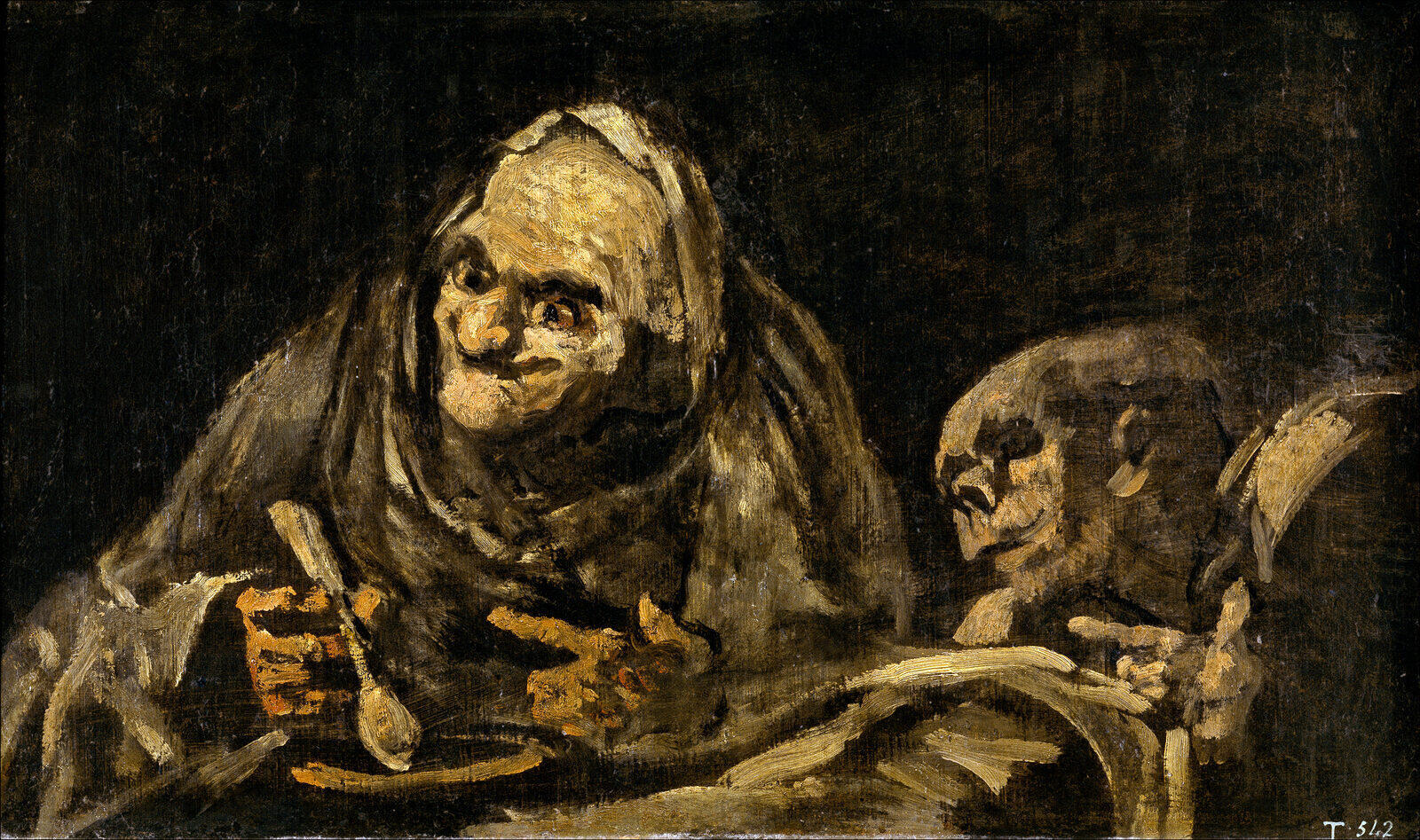
The Prado is the single essential destination for Goya. The Black Paintings (Rooms 67–68, ground floor) include Saturn Devouring His Son (c. 1820–23), The Dog, Witches' Sabbath, and Two Old Men Eating Soup. On the same floor, Room 64 holds The Third of May 1808 (1814) and The Second of May 1808. The first floor displays the tapestry cartoons (Rooms 85–94), including The Parasol (1777) and The Crockery Vendor (1779). Royal portraits fill Rooms 32–39, with The Family of Charles IV (1800–01) and the paired Maja Clothed and Maja Nude (Rooms 36–37). Allow 3–4 hours for the Goya rooms alone. Open Monday–Saturday 10:00 AM–8:00 PM, Sundays until 7:00 PM.

Book Museo del Prado tickets  |  Book Prado guided tour

Real Academia de Bellas Artes de San Fernando, Madrid

Key Goya self-portrait and religious works. Often overlooked, rarely crowded.

Located on Calle de Alcalá, a 15-minute walk from the Prado. The collection includes Goya's Self-Portrait (c. 1815), The Burial of the Sardine (c. 1812–19), and The Madhouse (c. 1812–19). Also on display are five panels from a series on bullfighting. Open Tuesday–Sunday 10:00 AM–3:00 PM (check for extended summer hours). Admission around €8.

Visit Real Academia de San Fernando (official site)

Ermita de San Antonio de la Florida, Madrid

Goya's dome frescoes (1798) and burial site. Free entry.

The small chapel contains Goya's only surviving monumental fresco cycle: the dome depicts the miracle of St. Anthony of Padua, painted in 1798 with remarkable fluency and a crowd scene that anticipates Impressionism. Goya was reburied here in 1919 (his skull was already missing). Open Tuesday–Sunday 9:30 AM–8:00 PM in summer, until 2:00 PM in winter. A 10-minute walk from Príncipe Pío metro station, and about 30 minutes on foot from the Prado.

National Gallery, London

Portraits and figure paintings. Free permanent collection.

Room 39 holds The Duke of Wellington (1812–14), famously stolen in 1961 and recovered four years later. Doña Isabel de Porcel (c. 1805), one of Goya's most striking female portraits, hangs nearby alongside A Scene from 'The Forcibly Bewitched' (1798). Free entry, no booking required for the permanent collection. From the National Gallery, Trafalgar Square, it is a short walk to the Courtauld Gallery at Somerset House, which holds a selection of Goya prints.

Book National Gallery London guided tour

Metropolitan Museum of Art, New York

Important portraits and late works. Book online for timed entry.

The Met holds several key Goya paintings in the European Paintings galleries (second floor, Rooms 617–620): Manuel Osorio Manrique de Zuñiga ("Red Boy," c. 1787–88), Don Sebastián Martínez (1792), Majas on a Balcony (c. 1800–12), and the late The Bullfight. The Prints and Drawings department holds complete sets of Los Caprichos and Los Desastres de la Guerra (shown in rotation). Suggested admission applies.

Book Met Museum guided tour

Musée du Louvre, Paris

Spanish painting galleries, first floor Denon wing.

The Louvre holds a small but significant group of Goya works: Marquesa de la Solana (c. 1794–95), Ferdinand Guillemardet (1798), and The Countess del Carpio. These are displayed in the Spanish painting rooms on the first floor of the Denon wing, close to the Murillo and Zurbarán galleries. Book at least a week in advance and enter via the Passage Richelieu for shorter queues.

Book Louvre guided tour

Art Institute of Chicago

Prints and paintings. European galleries, second floor.

The Art Institute holds Boy on a Ram (c. 1786–87), one of the tapestry cartoon studies, and a strong prints collection including sheets from Los Caprichos, La Tauromaquia, and Los Disparates. The European painting galleries are on the second floor of the original building. Allow 1–2 hours for the Spanish holdings.

Book Art Institute of Chicago tickets

Museo di Capodimonte, Naples

Bourbon collection with Goya connection. Book 2–3 days ahead.

Capodimonte holds a small number of Goya-attributed works connected to the Bourbon collections that linked the Spanish and Neapolitan courts. The museum's main draw for Goya scholars is contextual: understanding the court patronage networks that shaped his career. The museum is on the Capodimonte hill, reachable by bus from Piazza Museo Nazionale (about 15 minutes).

Book Capodimonte tickets
How to approach Goya

Goya's career spans roughly 60 years and encompasses royal tapestry designs, court portraits, religious commissions, print series, war paintings, and the late Black Paintings. Geography matters because Madrid holds the majority, but important works are scattered across London, Paris, New York, and Chicago. Planning by location prevents backtracking and ensures you see related works in context.

  • Start at the Prado: the tapestry cartoons (1770s–80s), the court portraits (1780s–1800s), and the Black Paintings (c. 1820–23) are all under one roof, arranged to show the full arc of his career.
  • Add the Ermita de San Antonio de la Florida on day two for his only surviving monumental frescoes, plus the Real Academia de San Fernando for intimate works and self-portraits.
  • For print specialists: the Biblioteca Nacional de España in Madrid holds original plates and impressions of Los Caprichos, Los Desastres de la Guerra, La Tauromaquia, and Los Disparates.

Main Goya clusters

Primary city

Madrid: Prado, Real Academia, Ermita de San Antonio

Over 130 Goya paintings at the Prado alone, plus the dome frescoes at the Ermita and intimate works at the Real Academia de San Fernando. Two full days recommended. The Prado's free evening slots (Mon–Sat 6:00–8:00 PM) attract long queues, so book a morning timed entry instead.

Book Prado tickets

Northern Europe

London, Paris, Amsterdam: portraits and prints

The National Gallery London holds The Duke of Wellington (free entry). The Louvre has Marquesa de la Solana and the Ferdinand Guillemardet portrait. Amsterdam's Rijksmuseum has a smaller selection. Plan these as additions to broader city itineraries rather than standalone Goya trips.

United States

New York, Chicago, Washington: paintings and print collections

The Met in New York has the strongest US Goya collection, including the iconic "Red Boy" portrait. The National Gallery in Washington holds Señora Sabasa García (c. 1806–11) and Thérèse Louise de Sureda. The Art Institute of Chicago complements paintings with extensive print holdings from Los Caprichos and La Tauromaquia.

Best city pages for Goya

Madrid

The Prado holds the Black Paintings, The Third of May 1808, the royal portraits, and the tapestry cartoons. Add the Real Academia de San Fernando and the Ermita de San Antonio de la Florida for a complete Goya itinerary in two days.

Open the full ArtAtlas map

Filter by Goya across all indexed museums. Useful for spotting nearby works when visiting cities like London, Paris, or New York for other artists.

Continue with Velázquez

Goya studied Velázquez's royal portraits intensely. In Madrid, Velázquez's Las Meninas is just rooms away from Goya's Family of Charles IV at the Prado, making the comparison immediate and physical.

FAQ

Where are Goya's Black Paintings?

All 14 Black Paintings are at the Museo del Prado, Rooms 67–68 on the ground floor. They were transferred from the walls of Goya's house (the Quinta del Sordo) to canvas in the 1870s. The room is dimly lit and can be crowded by midday; arrive early.

Do I need to book Prado tickets in advance?

Yes, especially from March through October and on weekends. Book online 3–5 days ahead for timed morning entry. Free slots (Mon–Sat 6:00–8:00 PM, Sun 5:00–7:00 PM) involve long queues and limited time. Book Prado tickets here.

How many days do I need for Goya in Madrid?

Two full days. Day one: the Prado (3–4 hours for Goya's rooms). Day two: Real Academia de San Fernando in the morning, then the Ermita de San Antonio de la Florida (free, 10 minutes from Príncipe Pío metro). If time allows, add the Museo Lázaro Galdiano for additional portraits.

Which Goya paintings can I see outside Spain?

London's National Gallery has The Duke of Wellington (free entry). The Met in New York holds Manuel Osorio Manrique de Zuñiga and Majas on a Balcony. The Louvre has the Marquesa de la Solana portrait. The National Gallery in Washington holds Señora Sabasa García. Major print collections exist at the Met, the Art Institute of Chicago, and the British Museum.

Can I visit Goya's frescoes in Madrid?

Yes. The Ermita de San Antonio de la Florida contains his dome frescoes (1798) and his tomb. Free entry, open Tuesday–Sunday. In summer, hours are 9:30 AM–8:00 PM. In winter, the chapel closes at 2:00 PM. Photography is allowed without flash. The chapel is compact, so visits take about 20–30 minutes.