Artist in city

Caravaggio in Florence

Caravaggio never lived in Florence. He passed through the city's orbit as a painter whose work moved through aristocratic patronage networks: Cardinal Francesco Maria Del Monte, one of his earliest and most important Roman patrons, had close ties to the Medici court and presented the Medusa to Grand Duke Ferdinando I as a diplomatic gift around 1598. That is how one of the most unsettling images Caravaggio ever produced ended up in Florence, where it has remained ever since.

Florence's Caravaggio is a museum Caravaggio. Unlike Rome, where major works are still in the chapels they were painted for, here all three paintings associated with him are in collections: the Uffizi holds the Medusa and the Sacrifice of Isaac; the Palatine Gallery at Palazzo Pitti holds the Sleeping Cupid, painted during the Malta period in 1608. The encounter is more detached than in a Roman chapel, but no less precise. This page gives you what each work is, where exactly to find it, and what you need to book.

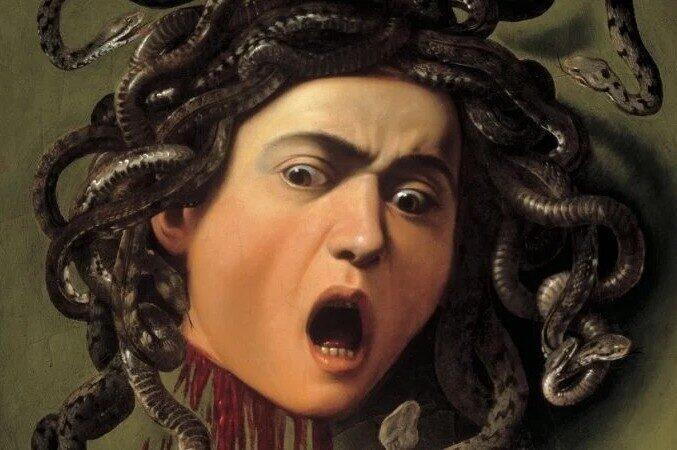
Caravaggio, Medusa (c. 1597), Uffizi Galleries, Florence

Caravaggio in Florence: interactive map

Tap to activate map

The Medusa: what it is and why it is in Florence

The Medusa (c. 1597) is painted on a convex wooden shield: a tondo approximately 60 cm in diameter, prepared as a parade or ceremonial object rather than a painting surface. The severed head of Medusa is caught at the moment of decapitation: blood streams from the neck, the mouth is open in a scream or gasp, the snake-hair still writhes. The convexity of the support makes the head appear to project outward from the surface, toward the viewer: an effect Caravaggio evidently calculated.

Cardinal Del Monte commissioned or acquired the work and presented it to Ferdinando I de' Medici, Grand Duke of Tuscany, around 1598: almost certainly as part of the diplomatic exchange that sustained Caravaggio's patronage network in these years. It entered the Medici Armoury, passed to the Uffizi collections in the eighteenth century, and has been there since. It is displayed in the Caravaggio room of the Uffizi alongside the Sacrifice of Isaac (c. 1603): a painting in which the drama of Abraham's raised knife is caught at the same arrested threshold between violence and reprieve that characterizes the Medusa, the Judith, and the David across Caravaggio's entire career.

Where to see Caravaggio in Florence

Uffizi Galleries: Caravaggio room

The Uffizi holds two works: the Medusa (c. 1597, on a convex shield, Room 90) and the Sacrifice of Isaac (c. 1603, Room 90). Both are in the section of the gallery dedicated to seventeenth-century Italian painting, which means you pass through the Renaissance rooms (Botticelli, Leonardo, Raphael, Michelangelo, Titian) before reaching them. Plan at least two hours if you want to reach the Caravaggio room without skipping the rest of the collection entirely. Advance booking is essential: the Uffizi is one of the most visited museums in the world and queues without a reservation can exceed two hours in peak season.

Book Uffizi Galleries tickets

Book a guided tour of the Uffizi

Palazzo Pitti: Palatine Gallery

The Sleeping Cupid (c. 1608) is in the Palatine Gallery on the first floor of Palazzo Pitti. It was painted in Malta, during Caravaggio's stay on the island after fleeing Naples, and arrived in Florence through the Medici collection. The subject: a boy asleep, identifiable as Cupid by the abandoned bow and quiver: is treated with the same unflinching physicality as his sacred figures: there is nothing idealized or conventionally charming about this sleeping child. The Palatine Gallery is one of the most densely hung museums in Italy, with paintings arranged as they were in the seventeenth century; budget 90 minutes.

Book Palazzo Pitti tickets

Book a guided tour of Palazzo Pitti

Fondazione Roberto Longhi

The Fondazione Roberto Longhi (Via Benedetto Fortini 30, in the Oltrarno hills south of the city) holds one autograph Caravaggio and one early copy after him. The original is the Boy Bitten by a Lizard (Ragazzo morso da un ramarro, c. 1596–97, 65,8 × 52,3 cm): a boy recoiling from a hidden lizard among fruit and flowers, the expression of shock caught with the same arrested-moment logic as the Judith, the Medusa, and the David. A second autograph version of the same composition is at the National Gallery in London; both are accepted as originals by the critical consensus. The collection also holds a Boy Peeling Fruit (Ragazzo che monda un frutto): a copy after a lost Caravaggio considered among his earliest known compositions, painted before or immediately after his arrival in Rome.

The Fondazione is not a public museum: it occupies the villa where the art historian Roberto Longhi and the writer Anna Banti lived. Access is through monthly guided visits on reservation, or for pre-formed groups of at least 10 by appointment. It was Longhi's 1951 exhibition at Palazzo Reale in Milan that effectively restored Caravaggio's international standing after decades of neglect. Check the Fondazione's website for the next available date before organizing the rest of the trip around it.

Florence is a museum city for Caravaggio

This is the key structural difference from Rome. In Rome, the Contarelli Chapel in San Luigi dei Francesi and the Cerasi Chapel in Santa Maria del Popolo preserve major works in their original devotional settings, free to enter, with the spatial logic Caravaggio designed for still intact. In Florence, there is none of that. Every Caravaggio in the city entered through aristocratic collecting rather than sacred commission. The encounter is inevitably more analytical and less spatially charged: but the paintings are no less significant for it.

Florence and the Medici patronage network

The Medusa's presence in Florence is a reminder that Caravaggio's Roman career depended entirely on the patronage of a small group of cardinals and aristocrats, Del Monte above all, who moved through the same court networks that connected Rome to Florence, Milan, and Spain. Without Del Monte's protection and his Medici connections, the Pio Monte della Misericordia commission in Naples, the Malta knighthood, and arguably the entire later career would have looked very different. Florence holds the material evidence of that network in one room of the Uffizi.
A practical Caravaggio itinerary in Florence

Three locations, two of which are standard museums and one that requires planning in advance:

  • Fondazione Roberto Longhi (book first): Check the Fondazione's website for the next monthly opening date and reserve your place before organizing the rest of the trip. The Fondazione is in the Oltrarno hills (Via Benedetto Fortini 30), about 20 minutes by foot from Palazzo Pitti or a short taxi ride. Visits are guided and typically last around 90 minutes.
  • Morning: Uffizi Galleries Open Tuesday–Sunday from 09:15. Book in advance: the museum sells out regularly. The Caravaggio room (Room 90) is in the second half of the gallery; allow at least two hours to move through without skipping the Botticelli and Leonardo rooms that precede it. The same section holds Artemisia Gentileschi's Judith Slaying Holofernes (c. 1620), one of the most direct responses to Caravaggio in European painting.
  • Lunch: The Oltrarno neighbourhood, just across the Ponte Vecchio from the Uffizi, has a dense concentration of restaurants. Palazzo Pitti is a 10-minute walk from the bridge.
  • Afternoon: Palazzo Pitti, Palatine Gallery Open Tuesday–Sunday from 09:15. The Sleeping Cupid is in the Palatine Gallery on the first floor. Allow 90 minutes; the Boboli Gardens are worth a short walk if the weather allows.

If the Fondazione Longhi is open on a day that overlaps with your trip, combine it with the Palazzo Pitti visit in the same afternoon: both are in the Oltrarno and the distance between them is manageable on foot.

More on TheIntroverTraveler

Florence canal view

Visiting the Uffizi Gallery

A practical guide to the Uffizi from someone who has spent a lot of time there: how to navigate the rooms, what to prioritize, and how to reach Room 90 where the Caravaggio, Artemisia Gentileschi and the other seventeenth-century paintings are.

The Medici Tombs

Michelangelo's New Sacristy in San Lorenzo is ten minutes from the Uffizi. A natural extension of any day in Florence that begins with painting and wants to end with sculpture.

The Deposition at Santa Felicita

Pontormo's Deposition (1528) in the Capponi Chapel at Santa Felicita is two minutes from Palazzo Pitti across the Ponte Vecchio. One of the most disorienting paintings in Italy, and almost always seen in near-solitude.

FAQ

Where can you see Caravaggio's paintings in Florence?

There are three autograph Caravaggio paintings in Florence across three locations. The Uffizi Galleries (Medusa, c. 1597, and Sacrifice of Isaac, c. 1603, both in Room 90) and the Palatine Gallery at Palazzo Pitti (Sleeping Cupid, c. 1608) are standard museums open to the public. The Fondazione Roberto Longhi (Via Benedetto Fortini 30) holds the autograph Boy Bitten by a Lizard (c. 1596–97) and a copy after the lost Boy Peeling Fruit: accessible by reservation only through monthly guided visits.

Is the Medusa by Caravaggio at the Uffizi?

Yes. Caravaggio's Medusa (c. 1597) is at the Uffizi in Room 90. It is painted on a convex wooden shield: a tondo about 60 cm in diameter: and arrived in Florence as a diplomatic gift from Cardinal Del Monte to Grand Duke Ferdinando I de' Medici around 1598. It has been in Florence ever since. It is displayed alongside the Sacrifice of Isaac (c. 1603) and works by other seventeenth-century Italian painters including Artemisia Gentileschi.

Does Florence have Caravaggio paintings in churches?

No. All three Caravaggio paintings in Florence are in museum collections: the Uffizi and Palazzo Pitti, rather than in churches or chapels. Caravaggio never received a sacred commission in Florence and never lived in the city. His works arrived here through the Medici collecting network, not through devotional patronage. If you want to see Caravaggio still in its original chapel setting, you need Rome: the Contarelli Chapel in San Luigi dei Francesi and the Cerasi Chapel in Santa Maria del Popolo are both free and require no booking.

Can I see the Uffizi and Palazzo Pitti in the same day?

Yes. The two museums are about 15 minutes apart on foot across the Ponte Vecchio. Morning at the Uffizi (plan two hours minimum to reach Room 90 without rushing), lunch in the Oltrarno, afternoon at Palazzo Pitti is a practical and unhurried sequence. Book the Uffizi and Palazzo Pitti well in advance: both sell out regularly in high season.

A severed head on a shield. In Florence since 1598.

The Medusa came to Florence as a diplomatic gesture between two powerful men, Del Monte and Ferdinando de' Medici, and has not left since. It is not a chapel painting, not a sacred commission, not an object made for devotion. It is a demonstration piece: this is what this painter can do with a convex shield and a mythological subject. It remains one of the most concentrated images of Caravaggio's early Roman period, and it is in Room 90 of the Uffizi. Use the map to plan the visit.

.js">